Koki'o Mini
I too have been caught by “mini mania”. More precisely, I have always wondered how tiny a ukulele can become while still producing a genuinely usable sound. We can dispose of the opposite end of the scale fairly quickly, because the baritone is really closer to being a small four-string guitar. But where is the sweet spot between miniaturisation and playability? I already explored this question in two posts several years ago after coming across one or two YouTube videos. If you are interested, take a look at the posts “Size Doesn't Matter!” and “Size Doesn't Matter II.”. Now I would like to introduce the Koki'o Mini ukulele:
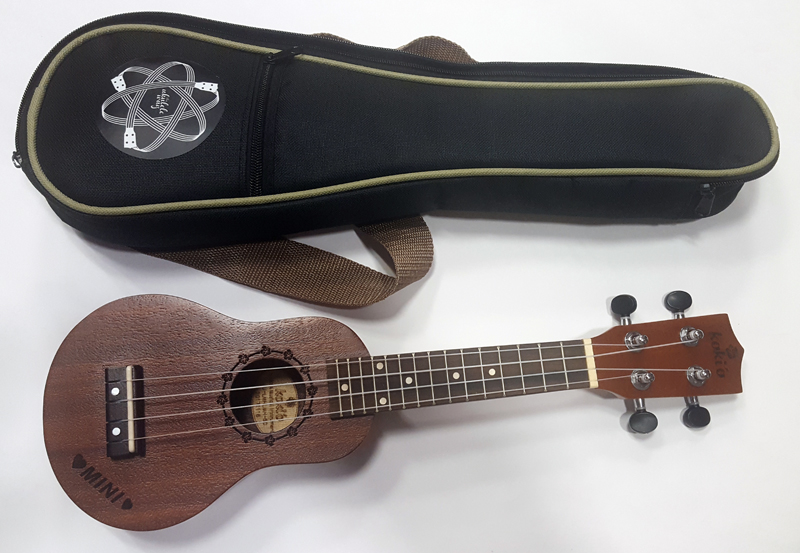
Almost everyone who sees this ukulele reacts with some version of “Oh, how cute!” – and for good reason. The instrument really does have a baby-like appearance. On the internet you will find all sorts of names for ukuleles smaller than a soprano, which causes endless debate among players and may never be settled definitively. Roughly speaking, however, the hierarchy goes like this: below the soprano comes the sopranino, then the piccolo, then the nano, after which you probably need a magnifying glass. Every website, manufacturer and forum seems to use slightly different names for these extra-small ukuleles. There is broad agreement that a sopranino is only slightly smaller than a soprano; below that, however, the naming becomes much more varied. I would classify the Koki'o Mini as piccolo size. If you have the time, search around the internet and Facebook. Many small workshops – in the UK, Brazil and elsewhere – have pages from which you can order handmade piccolo- or nano-size ukuleles. They are not cheap, but they look genuinely playable. And of course there are also factory-made little instruments like this Koki'o.
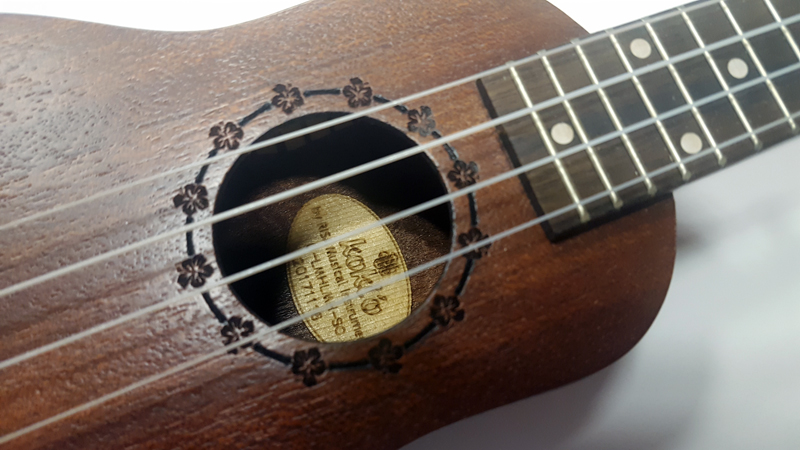
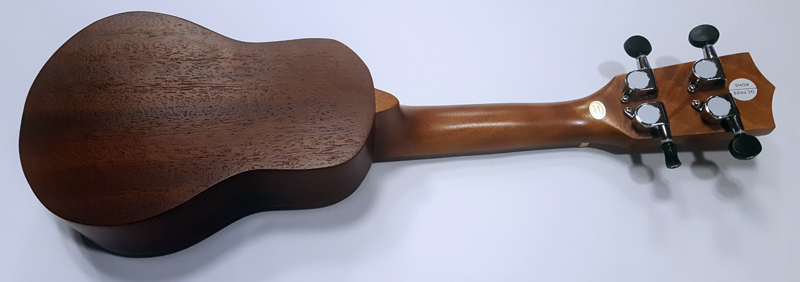
At the end of July, then, I adopted one of these adorable little instruments and naturally began playing it immediately. My most important first impressions were these: the little thing is head-heavy because the metal tuning machines are not balanced by much weight in the neck and body. It is almost impossible to hold it using the usual “wrap my arm around it and hold it against my body” method; sooner or later one of your hands has to support it. And finally, you have to relearn the fingering of a few chords, because hand and finger positions that work easily on a soprano are sometimes simply too large for this tiny instrument.
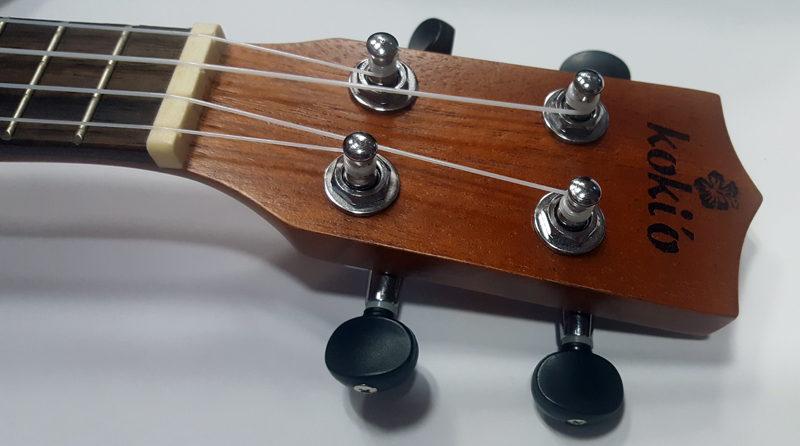
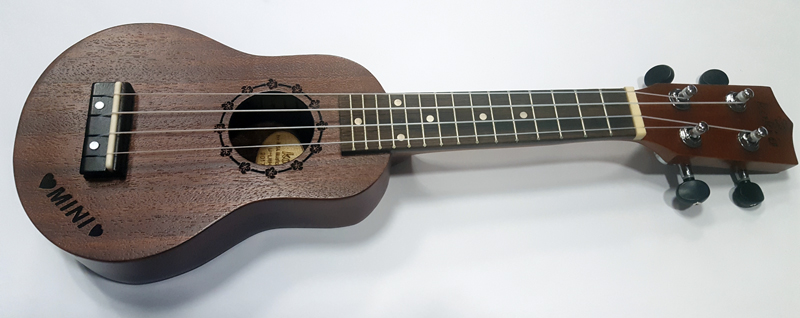
Believe it or not, this instrument produces perfectly usable notes, although they do not ring for very long. Above roughly the fourth or fifth fret, the instrument starts producing more of a pitch-specific sound effect than a clear ringing note, so it is best not to venture too far up the neck. Stick mainly to chords in the first few frets with only a little melody playing and the experience becomes unexpectedly entertaining because it squeaks away rather nicely . I use the word squeaks deliberately. Besides everything mentioned above, there is another interesting feature: the factory tuning is not GCEA but DGBE, meaning the strings are already pitched higher even when played open. Where have we seen DGBE tuning before? On the baritone ukulele, of course. The difference is that, for example, the baritone's D string sounds two octaves lower than the Mini's D string. It follows that the chords on this Koki'o Mini are fingered in exactly the same way as on a baritone ukulele. And the baritone itself uses the same shapes as a “normal” GCEA ukulele – only they produce different chords. The familiar 0003 C-major shape from a GCEA ukulele produces G major on both the baritone and this tiny instrument! So the brain, if trained for GCEA, needs a little exercise as it constantly transposes the chord shapes until the DGBE chord relationships become automatic as well. Rather than stretching this explanation even further, let us see and hear what we can do with this miniature instrument. I also try to demonstrate the transposition trick in the video. If you would like to read more about it, click here to read the post about the baritone ukulele.
The same question probably occurs to you as it did to me: all right, it is pretty and interesting, but what is it actually for? To be honest, that is difficult to answer. It is more of a fun or party instrument. It is even easier to carry than a soprano ukulele, can be pulled from an inside pocket almost anywhere, and when it appears everybody's jaw drops: “How is that even possible?” . This probably should not be your first ukulele – in fact, definitely do not make it your first – but once the collecting bug bites, sooner or later many ukulele players will want one of these tiny creatures. And actually, it fits rather nicely in the hands of a six- or seven-year-old child. They could genuinely start on one.