Blue Moon of Kentucky
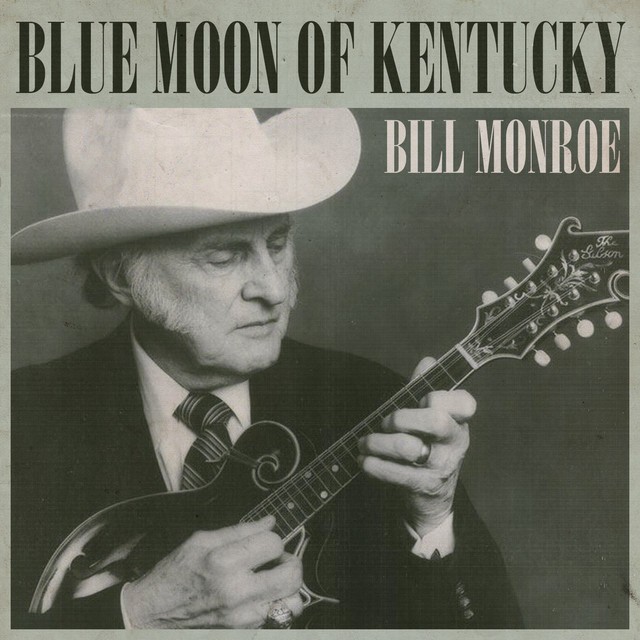
I hope there are some bluegrass fans among you, because I would like to show you the chord accompaniment to one of the genre's evergreen classics. Bill Monroe wrote the song in 1946 — at least that is what he said; I do not understand why Wikipedia gives 1945 — and recorded it that year with his band Bill Monroe & the Bluegrass Boys. In the decades that followed, hardly any major artist seems to have escaped recording a version, including Elvis, McCartney, John Fogerty of CCR and many others. Bill Monroe, incidentally, is regarded as one of the creators of bluegrass itself and is often called the father of bluegrass.
Bill Monroe had an incredibly high, powerful voice that he retained even in old age. He played mandolin, a small eight-string plucked instrument with considerable volume and a highly characteristic tone. The song begins with a slow introduction, then after a change of tempo — and time signature, from 3/4 to 4/4 — we are immersed in the full bluegrass sound and can enjoy how beautifully banjo, fiddle, mandolin, guitar and double bass work together. If you do not know the song, here it is:
This version above is actually the composer's own later reinterpretation of his song, because he did not always perform it that way. Perhaps after several decades even Bill could no longer stand playing the entire thing at the slow tempo , because the original 1946 recording stays slow and in 3/4 throughout:
In 2000, John Fogerty — founder and singer of CCR — recorded a sensational version that paid a fitting tribute to a song that was 55 years old at the time and is now 76. Fogerty kept a few bars from the beginning of the original, then moved into a modern, slightly rock-oriented arrangement with wonderful solos and somewhat altered lyrics. Here it is:
The song is built around three — at most four — chords, so it can also be ideal for beginners who want to practise switching among three chords. I say “at most four” because some arrangements use the dominant-seventh version of one of the chords, although the song sounds great on ukulele even without adding the seventh. I play along with Fogerty's arrangement, which is in A major, so we need the following chords:
 |
 |
  |
Beginners, please do not be discouraged by the presence of E major. You can choose either of the two shapes shown here. Even if it feels difficult, it is worth practising E major diligently— sooner or later it will work, both versions. And as I say and demonstrate in the video, the song can of course be played in other keys too; you simply will not be able to play along with Fogerty's recording in that case.
Unfortunately, the technology gremlins were not kind to me during either recording or editing. I had to align the audio track of the video above with my own video afterwards. I did my best, but the synchronisation is still not perfect in one or two places. I hope you can nevertheless clearly see and hear what I want to demonstrate on the ukulele. Here is the video:
Every arrangement seems to come with its own small or large changes to the lyrics. This time I wrote the chords into the original 1946 lyrics, which you can also find under Downloads(where I have also written them out in C major). The placement and timing of the chords did not change in Fogerty's version compared with the original, so I do not think you can get lost even if you follow the 1946 version. And, as mentioned above, you do not have to include the seventh chords:
[A]Blue moon of [A7]Kentucky keep on [D]shining,
Shine [A]on the one that's gone and proved un[E]true,
Blue [A]moon of [A7]Kentucky keep on [D]shining,
Shine [A]on the one that's [E]gone and left me [A]blue. [A7]
It was [D]on a moonlight night the [A]stars were shining bright,
When they [D]whispered from on high your [A]love has said good[E]bye,
Blue [A]moon of [A7]Kentucky keep on [D]shining,
Shine [A]on the one that's [E]gone and said good[A]bye.