
Transposing — for Beginners Too!
With another music-theory post that is also highly practical, we would like to help you find your way around keys a little more confidently. You may already have heard the word “transposition” — perhaps in music class or elsewhere, maybe even as a swear word — and found it more frightening than useful. In simple terms, transposition means changing from one key to another. Sooner or later every musician encounters it; you may even be doing it already without knowing what it is called.
Let us take a practical example. Suppose we start accompanying a song whose first chord is C major. A brave volunteer even agrees to sing it, so our ukulele is accompanying a vocalist. Suddenly the singer says, “This is too high for me. I can't reach the top note. Couldn't you play it a little lower?” Like any yes-or-no question, we can answer either yes or no. As a beginner it is perfectly acceptable if our answer is “no”, but eventually we ought to be able to say, “Of course — what key would you like?” The singer may then do one of two things: either name the key (excellent — this singer knows their vocal limits precisely), or say, “I don't know, just a little lower.” In the latter case we start thinking a tone or two lower.
If the paragraph above has not scared you away yet, let us approach the same idea from another angle. Believe me, dear reader: if you have stayed with this post this far, you are on the right track and by the end the pieces will fit together. Suppose our song starts with C major, continues with G major, then A minor, F major and C major again. In the bridge we hear D major, A7 and F-sharp minor. And all of this is simply too high for our troublesome singer.
What can we do? Transposition lets us slide every chord down or up by the same amount while keeping the distances between the chords unchanged. That is the key sentence; let it sink in. The foundation of music theory is, after all, mathematics. The roots of the chords listed above — C, G, A, F, C, D, F, regardless of whether each chord is major, minor or something else — are separated by fixed musical distances called intervals. When we change key, downward in our example, we might decide to play A major instead of C major. But if the original song moved from C major to G major, our new A major cannot simply be followed by the original G major; the G major has to be moved too. By how much? Exactly the same amount as the C major. C has been lowered by a minor third to A; a minor third below G is E, so G major becomes E major after transposition. We work through every chord in this way, moving each one by the same interval so that their relationships remain unchanged.
That, in brief, is the theory of transposition. It is not especially simple on first reading, and putting it into practice is not always easy either. That is precisely what the chart below is for: it replaces the mental gymnastics above and gives you a complete key for transposing. For advanced players, the calculation above usually takes only a few seconds. Naturally that cannot be expected of beginners, but the more often you transpose, the easier it becomes — eventually you begin thinking in functions rather than individual keys, but that is another story.
So, after all that, here is a useful transposition chart:
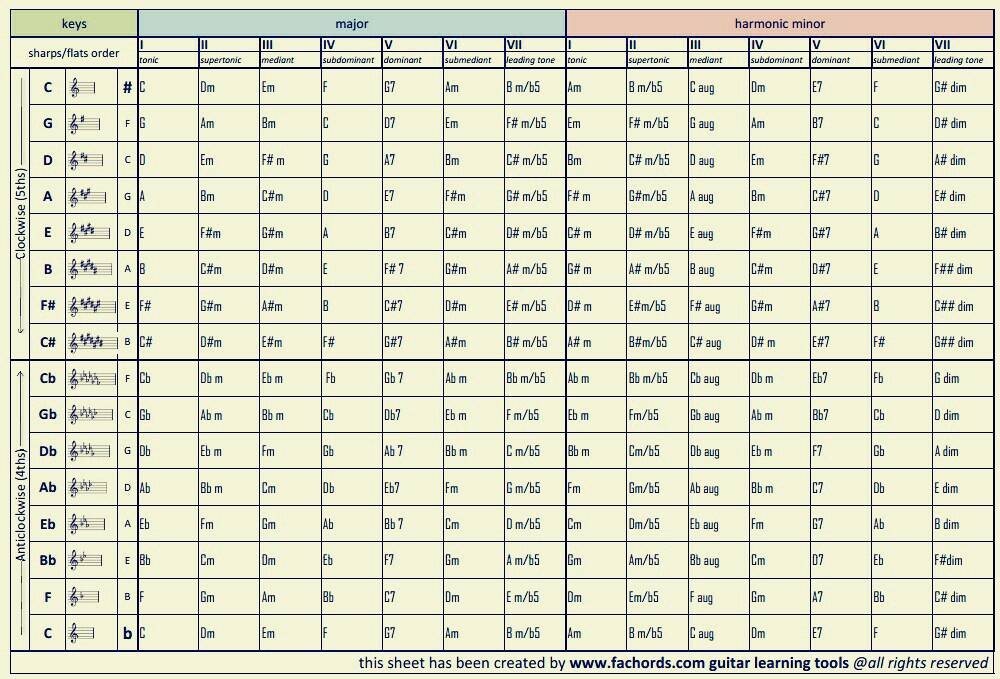
Click it to open a slightly larger version in a new window!
Even this chart may look complicated at first, but it is not; you only need to know what you are looking at. Let us solve the previous example with it. We had a song beginning in C major and wanted to move the entire thing lower. At minimum, we need to know that the letter-note names run upward in pitch as C – D – E – F – G – A – B – C [– D – E etc.]. So if we move downward from C, B is already lower, but in our example we chose A (we could have chosen another target key). In the table, the original key is represented by a row and the transposition by the corresponding position in another row. Because we started in C major, we find the row beginning with C — the first row. We want the transposed song to use A major where the original used C major, and all the other chords to move accordingly. So we find the row beginning with A and then simply match positions between the two rows. If the original key uses F major, put your finger on F in the C-major row, then move it down to the A-major row: the answer is D major. Repeat the process for every chord and the transposition is complete. If useful, write the new chords above the lyrics.
If we memorise intervals — a topic discussed, among other things, in an earlier post (Music Theory Basics — for the Patient!) — then transposition really can become a mental operation that replaces the table above. Suppose, for example, that we want to play a song originally in G major in D major. We know that D is a perfect fourth below G, so every chord must be transposed down by a perfect fourth. At a glance we then know that E major becomes B major, C major becomes G major, and so on. This naturally takes some practice. One way I practise it — a nice bit of brain training — is to look at a lyric sheet with chords written above it. Familiar, right? I then try to transpose on sight. Before I start playing I arbitrarily decide, for example, to play the song a whole step higher. If the sheet says A major, I play B major instead. When I see E major, I automatically fret F-sharp major; C major becomes D major, and so on. When I finish, I might play the whole thing a minor third lower instead. And so on. It is easy to tie your brain in knots, especially when a song contains many different chords, but that is fine: the exercise sharpens the mind and makes us increasingly comfortable with less familiar chords outside our usual set. Good luck and enjoy practising!