All Ukulele Chords (for Intermediate Players)
You probably know the joke: "How many push-ups can Chuck Norris do? All of them." Now we are going to try to be Chuck Norris and put all the chords into a single chart. It may be easier for more advanced players, but I certainly do not want to discourage beginners either: anyone who understands and memorizes the following chart will have taken a huge step forward on the rocky road of learning chords.
If we take a closer look at the different chords and their "patterns", we can see that some chords seem to be related to one another. I do not mean comparing a basic C major with G major. Instead, take a B-flat minor chord - 3111 - and a B minor chord - 4222. You can see that all you have to do is slide the same hand shape up or down the neck. The fingerings 3111 and 4222 themselves show that several chords can be played with exactly the same hand position; you simply move your hand along the neck.
The basic C major chord we have already mentioned - 0003 - fits the same pattern as well. We do not fret the upper three strings because the ukulele's nut effectively does that job for us. Move the same shape up by one fret - 1114 - and we immediately have C# major, and so on. I have already discussed all this in an earlier post, where I also explain it in a video.
So here is the beginning of a large chart showing exactly what this means, using major and dominant seventh chords as examples. You can find the complete chart in the bottom section of the "Chords" menu item.
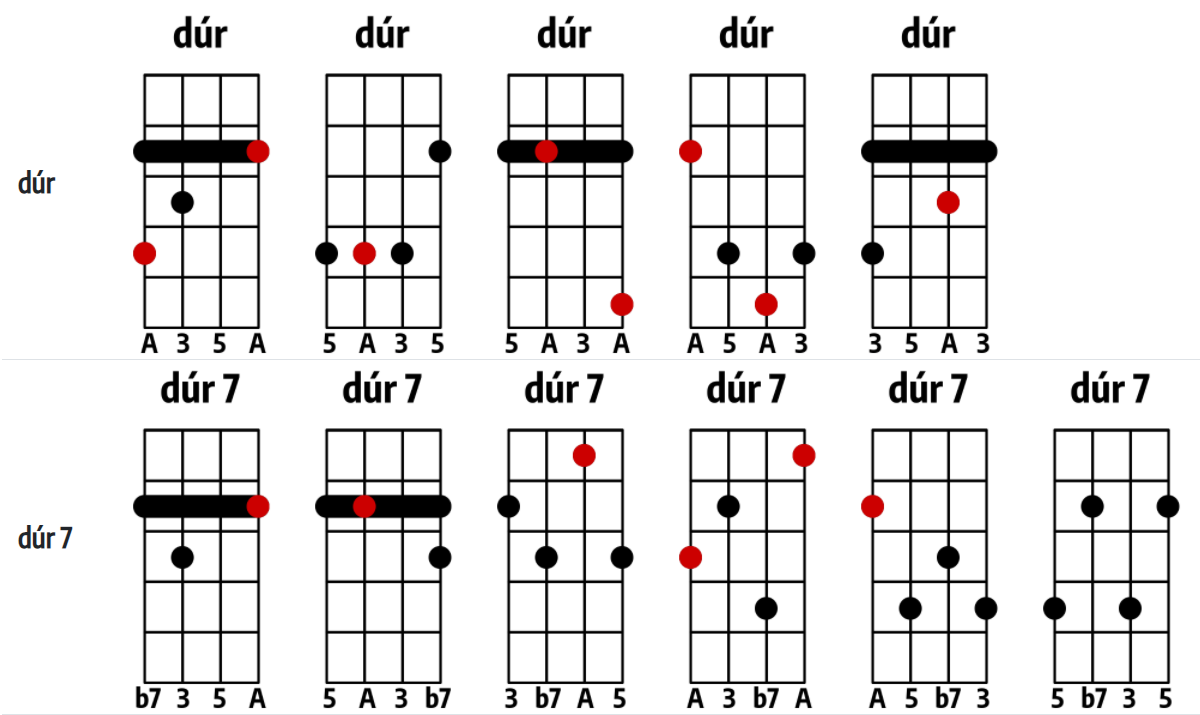
If, for example, we want to play an F major chord, in theory there are five different ways to finger it, not only the familiar 2010 shape. It may sound unbelievable, but the chart above includes all of them: naturally, F major is the fifth fingering in the Major row. For F major we do not fret the positions in the pattern beginning with 5 and 3, because the ukulele does that for us with its open strings - there is nothing to press down there when playing F major.
To understand the chart we need at least a tiny amount of music theory. In the chart, "A" marks the root note. The 3 means a major third, b3 a minor third, 5 a perfect fifth, and so on, although we do not need to worry too much about those details. The most important thing is to watch the "A" positions. If, for example, we want to play a B major chord, we look for a B on any string; once we find it, that position becomes the "A" in the pattern. If we look for B on the G string, it is on the fourth fret. From there, all we have to do is place the other fingers. In this case - because we located B on the G string - we can use the first pattern in the Major row to play B major. In the same way, we can find any variation of any chord from the chart, and later from memory. The chart also shows how the other notes making up the chord - some of which may themselves be root notes in another context - are positioned within the chord shape. It is really just a little mathematics and memorization. It may look rather complicated at first, and some fingerings are so uncomfortable that we never actually use them.
Overall, I could also say that the "Chords" menu item's bottomchart is a condensed summary that can replace the long chord charts listing C major, D major, E major and so on separately. It would take quite a person to memorize the entire chart word for word - and that is probably unnecessary - but learning the different fingerings of the basic chord types (major, minor and seventh chords) can be extremely useful. Once again, beginners should not be frightened by this chart, and there is nothing wrong with not starting your ukulele journey by learning it. Feel free to use the long, detailed chord charts first; over time you can gradually switch to this one .