Soprano, Concert or Tenor?
A minor religious war is slowly developing on both Hungarian and international forums over whether a beginner should choose a soprano or a concert ukulele as their first instrument. Or perhaps a tenor. I decided to make a blog post and video about the subject, explaining and showing in detail where I stand. Naturally, my view is not sacred truth. It is simply my personal opinion based on the experience I have accumulated over the years, and I would like to point out a few factors that complete beginners may not think about before buying their first ukulele.
When buying a ukulele, one of the decisive factors is understandably the price. Since soprano is the smallest standard size — let us ignore the even smaller instruments for the moment — it requires the least material and this is reflected in its price. Within one model family, where the same materials and design are used, the larger concert version requires more material, the tenor more again, and the baritone the most. Prices therefore generally rise with instrument size. Many people decide not to take much risk and buy a soprano because it is the cheapest option, planning to add a concert or tenor later if ukulele playing turns out to suit them. There is nothing wrong with starting that way, but the important question is whether a soprano, as a beginner's instrument, provides the same comfortable playing experience over many months as, for example, a concert size.
I also understand people who say the "real" ukulele is the soprano, because the world's first ukuleles were made at roughly that size. Even so, the small dimensions naturally come with limitations, and larger ukuleles have clearly been made for many decades for good reasons.
Comparing soprano and concert ukuleles, the frets on a concert are wider, so our fingers have more room. For a beginner who is already struggling to place a finger quickly and accurately on the correct fret when forming a chord, that extra width can be helpful. The smaller frets of a soprano make things more difficult in this respect. I demonstrate this in detail in the video, although I do not mention there that crowded chord shapes can also be easier to finger on a ukulele that gives the fingers more space. Think, for example, of D minor, which is noticeably easier to finger on a concert ukulele than on a soprano.
The soprano body is also smaller than the concert body. On a concert ukulele it is generally easier to learn and practice how to hold the instrument. Naturally this also depends on our own build. For a smaller person the issue may hardly appear, but in the hands of a large man a soprano can feel tiny, and as a beginner he may struggle simply to hold it securely.
Most soprano ukuleles also physically have fewer notes available. I am not talking here about long-neck sopranos, which manufacturers developed partly to provide those "missing" notes. A typical soprano has about one octave's worth of frets — depending on the manufacturer perhaps twelve to fifteen. That means that after a few months, when a beginner starts exploring farther up the neck and perhaps playing melodies, they may quickly feel that the soprano's range is limited. The fret spacing mentioned above also becomes extremely narrow in the high register of a soprano, making accurate note placement genuinely difficult.
Volume and tone: soprano ukuleles have a slightly boxy, unmistakable, charmingly traditional ukulele sound. Even a concert ukulele already sounds somewhat fuller and more substantial, not to mention a tenor. Obviously the larger the instrument, the more volume we generally expect, although the type of wood also plays an important role — just as tone is affected by the species of wood and whether it is solid or laminated — together with bracing, soundhole placement and other construction details.
Do not misunderstand me: I really like soprano ukuleles too, but I am not convinced they are always the ideal first choice for beginners. Another way of putting it is that every ukulele collection should probably contain a soprano, but perhaps it does not necessarily need to be the first instrument. With experience and practice, playing a soprano — or switching to one from a concert-size ukulele — becomes much easier.
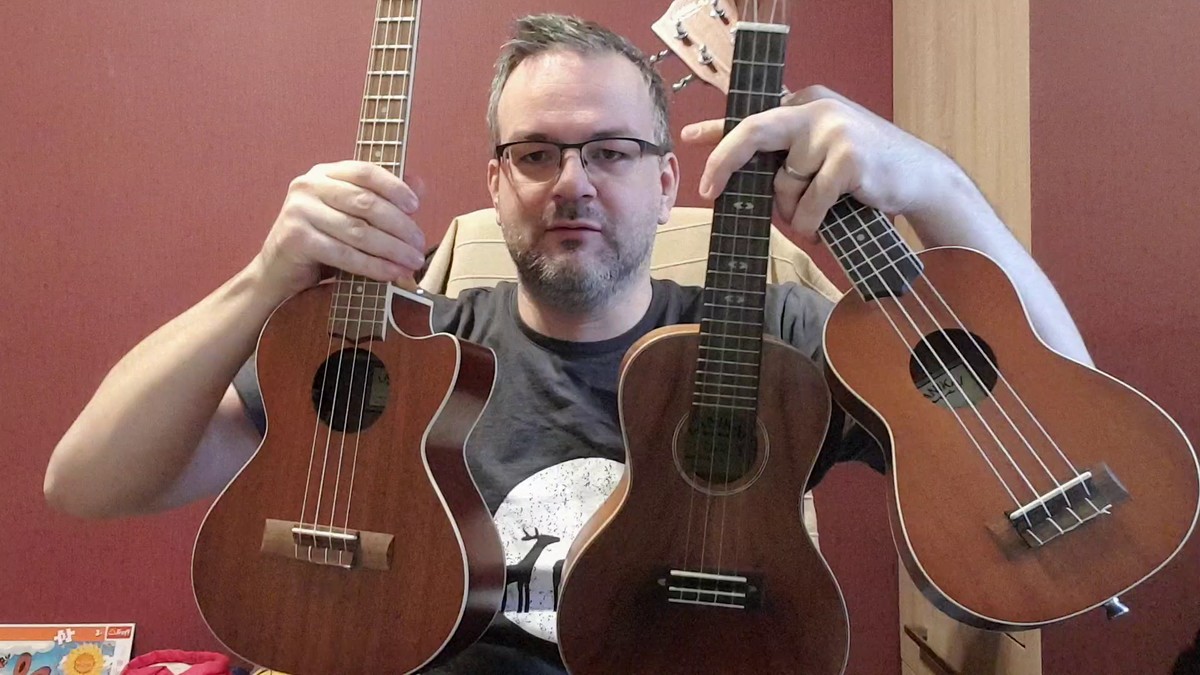
So far we have compared soprano and concert sizes, but what about tenor and baritone? Since I play tenor most of the time, I am naturally biased toward tenors. The greater range and volume, together with the wider fret spacing — and the length of my fingers — make tenor ideal for me. I frequently play both melodies and chords above the 12th fret and use almost the full length of the ukulele neck, so fret width in the higher register matters to me. Anyone with larger hands or wider fingers may therefore find a tenor just as suitable as — or even preferable to — a concert. I would say the same for guitarists, who are accustomed to the enormous fret spacing of a guitar compared with a ukulele.
Speaking of guitarists, the baritone is also closest to the guitar in tuning, because most baritones come with DGBE strings. That makes the transition relatively easy and the playing experience familiar. (GCEA string sets are also available for baritone.) Baritone is the size I recommend least often to complete beginners, because in many ways it really is more like a small guitar. Of course, if someone falls in love with a baritone, they can certainly learn on it too. But when strung with a low D, it has the least traditionally ukulele-like sound of the common sizes.
From the thoughts above you have probably guessed that for complete beginners I usually recommend concert size — or possibly tenor. As I wrote at the beginning, these are my personal views based on years of playing and teaching ukulele. Other experienced players may naturally think differently, and I fully respect their opinions. Before buying, I recommend reading and listening to as many different views as possible so that you can make the decision that feels right for you.
In the video I do not discuss the question of children — what if we are buying a ukulele for a child? For them, a soprano can of course be a perfect choice. They are unlikely to venture above the 12th fret at first, the narrower fret spacing suits their smaller fingers, and the smaller body is easier for them to handle. Then, if they practice persistently and grow a little, they will start asking for a concert-size one .
Finally, here is the video in which I carry out and demonstrate the comparisons described above — size, fret spacing and range: