
A Question of Fingernails
If there can be a thorny question, perhaps there can be a nail-related one too . And no, this is not about nail salons . Over the past few years I have received several emails about “fingernail policy”, so I thought the topic deserved a short post. Interestingly, questions have come from both directions. One female reader was worried about her longer nails and asked whether she would have to get rid of them if she wanted to learn the ukulele. Another reader, meanwhile, asked whether he should grow his nails in order to strum the strings properly. It is difficult to answer in a single sentence, although anyone will quickly discover the answer for themselves after buying their first ukulele.
Let us start with the easiest case: artificial nails are out. At least in my opinion. I do not think they would survive the wear and tear of playing, and they get in the way both of strumming and of fretting chords. So, dear girls, ladies (gentlemen??? ), forget artificial nails if you want to play ukulele. Naturally grown nails are a different matter. More advanced players — especially on the strumming or picking hand — can afford to keep longer nails, but on the other hand, the one used to fret chords, long nails should still be avoided. Why? Very simple: they get in the way, and for certain chord shapes they can make clean fretting almost impossible.
With one or two simple chords you may be able to work around a long nail so that it does not interfere — C major, for example — but anyone who wants to fret chords cleanly and accurately, or perhaps also play melodies, cannot really afford long nails on the fretting hand. We often turn the fingers almost directly towards the neck of the ukulele because we press the strings against the fretboard with the fingertips — especially the very ends of the fingers close to the nails. With long nails, certain chords may become physically impossible to fret because the nail gets in the way and prevents the fingertip from reaching the string. I have seen people once or twice trying to fret chords with longer nails... they struggled considerably, twisting their hands into awkward positions to keep the nails out of the way. It looked more like suffering than good hand position. In short: on the hand used for fretting chords, neat short nails are preferable.
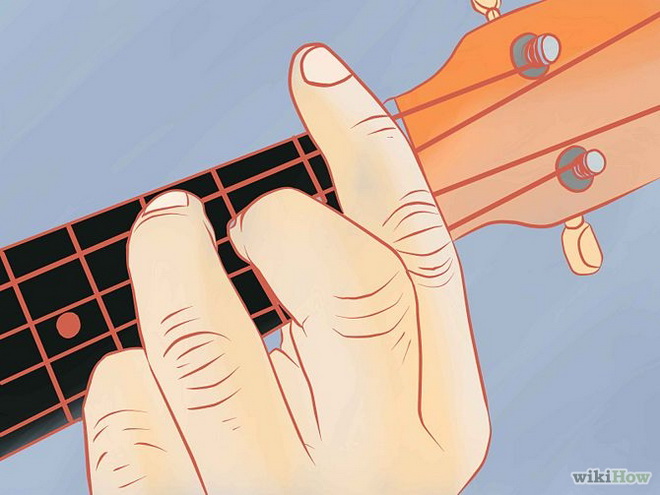
This barre chord, for example, would be extremely difficult with long nails.
The situation is slightly different with the nails on the strumming or picking hand. Even on international forums there is endless debate about whether a plastic pick should be used on a ukulele. I think the sensible answer is: why not? Whatever feels comfortable to the player, even though a pick is not part of traditional ukulele technique. Some people effectively replace a plastic pick with longer fingernails, which can make arpeggios and melody playing easier. There are arguments both for and against long or short nails on the picking hand. If someone is a professional musician and has practised for years and developed a style that uses long nails, then by all means keep them. I am not a professional musician, however, and in everyday life it would look rather strange if the nails on my left hand — the fretting hand — were short while those on my right were long. I therefore favour short nails on both hands. I can still play arpeggios and pick melodies; the sound may simply be a little softer and quieter than with a plastic pick or a long nail. Short nails on the strumming hand are also useful, especially for beginners, because when we are not picking individual notes but simply “scrubbing” through chords, long nails will not scratch across the ukulele body or catch in the sound hole. You also feel the strings better as the surface of the nail passes over them than when only the tip of a long nail skates across.
To sum up: for complete beginners I recommend short nails on both hands. Later, anyone who wants to can experiment with longer nails on the picking hand, but on the hand used to fret chords I can only recommend short nails.
The situation becomes even more colourful if someone also plays a string instrument on which long nails are needed for playing. What should that person do? Play ukulele while the nails are short, then switch to the other instrument when they grow .
We would love to hear the experiences of both beginners and advanced players in the comments!