
Buying a Ukulele
Ukuleles can be bought from as little as HUF 2,000–3,000, while top models can cost several hundred thousand forints and may even exceed one million forints.
First of all, I would strongly advise everyone against the ukuleles that cost only a few thousand forints, unless what you want is a dust collector — in other words, an unusable piece of junk. Every component in instruments like these is made from extremely low-quality material, and the assembly is poor as well. Cheap ukuleles tend to punish you quickly: they go out of tune easily, are difficult to tune accurately, and even if you manage it, the chords may still sound false despite correct open-string tuning. Their tone is unattractive, they do not resonate well, and so on. An instrument of such poor quality can easily put someone off learning the ukulele altogether.
Absolute entry-level ukuleles are available for around HUF 20,000, although the price usually does not include a case (this depends on the manufacturer) or a tuner. A case is needed for safe storage and transport. A phone app can replace a tuner, but it is difficult to use in a noisy environment. A tuner costing a few thousand forints works reliably even in noise and takes one movement to clip on, while a phone app can sometimes involve a bit of fiddling with settings, pop-up adverts, modes and so on.
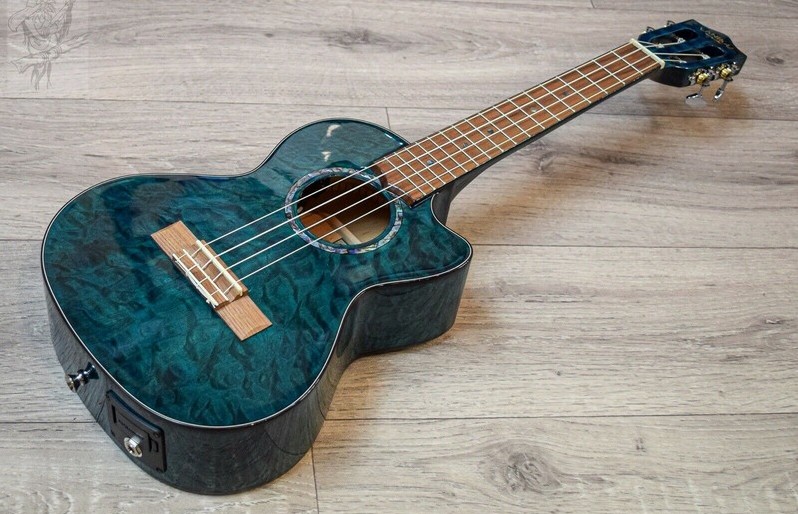
If our budget allows, it is worth stretching a little further and perhaps looking for a ukulele whose price includes a factory case. Then all we need is a tuner and we already have our “beginner ukulele set”. Anyone who can afford it should therefore look around the HUF 30,000 price range. Between roughly HUF 30,000 and 40,000 you can already find attractive, good-quality instruments, and of course — as I mentioned above — the sky is the limit. The picture below shows one of my favourite instruments, a Lanikai. These are the ukuleles I most often play at ukulele meetups and courses:
Price therefore tells us quite a lot about an instrument, and the old saying “you get what you pay for” certainly applies to ukuleles — and musical instruments generally. If the manufacturer does not include a case, it is worth buying at least a soft gig bag. I am a believer in hard and semi-hard cases because they protect the ukulele well. If you buy a “bare” ukulele with neither case nor tuner, those two accessories may add another HUF 5,000–10,000 to the cost.

When choosing a ukulele we also need to decide what size we want. The first post explained that ukuleles are essentially made in four main sizes: soprano, concert, tenor and baritone, which is also their order from smallest to largest. Everyone has to decide for themselves which size they want. If you have never seen a ukulele in person, definitely find a music shop where you can hold one before buying, because purchasing one sight unseen is fairly risky. In my opinion a soprano ukulele can be very small for men; someone with medium-sized hands may find chord shapes relatively difficult to fret. Men with very large hands should probably not even try a soprano; concert, tenor or baritone sizes are more suitable, and chords also tend to resonate more fully on them. Smaller hands, on the other hand, often fit a soprano comfortably. It is also worth remembering that the relationship is not only between fingers and fretboard: the size of the player's entire arm relative to the ukulele body matters, especially on instruments without a strap, because the strumming-arm elbow and upper arm help hold the instrument while playing. A large person may find a soprano extremely awkward because it is too small relative to the length of the arm. This too is partly a matter of practice and habit, but a beginner should certainly take personal proportions into account when choosing an instrument that “fits”.
Apart from price and size, other important factors when choosing a ukulele include the wood it is made from (and whether it is laminated or solid), its colour and equipment — for example whether it has a strap button — whether the price includes a factory case, and whether it is acoustic or electro-acoustic. The latter start at around HUF 40,000.A useful feature of an electro-acoustic instrument is that it still has a normal acoustic sound and volume without an amplifier, speaker or any other gadget: in that situation it behaves like an ordinary acoustic ukulele. But because it can also be connected to an amplifier and effects, it can become a full member of a larger band and produce some incredibly interesting sounds.
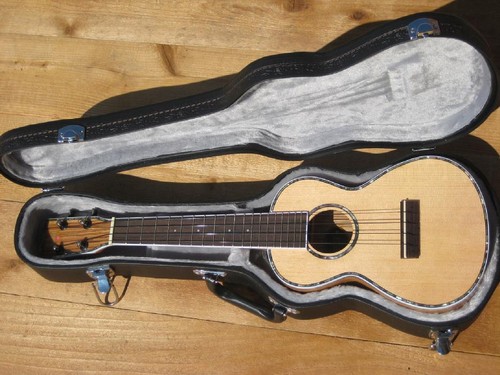
Republic #605 in a hard case
Here is a short, by no means exhaustive, list of ukulele brands:
Abbott, Ana'ole, Antoniotsai/ Hanworks, aNueNue, Applause (Ovation), Aria, Ashbury, Ashton, BeBop, Beltona, Brownsville, BugsGear EleUke, Bushman, Clearwater, Cole Clark, Collings, Earnest Instruments, Cordoba, Favilla, Fender, Flea, Fluke, Gibson, Greg Bennett (Samick), Gretsch, Hamano, Harmony, Hawaiia Ukulele Company, Hilo, Honu, Ibanez, Johnson, Kala, Kamaka, Kanile'a, Kau'wela, Keli'i, Kiwaya, Fender, Keech, Ko'olau, Koa Pili, Koko, Keli'i, KoAlana, KoAloha, Kumalae, Laka, Lanikai, Lazy, Le Domino, Lehua, Leolani, LoPrinzi, Luna, Lyon and Healy, Maccaferri, Mahalo, Makai, Makala, Martin, Mele, Mid, Mitchell, Morelli/Santini, National, Ohana, Ookook, Oscar Schmidt, Pahu Kani, Pono, Regal, Republic, Riptide, Rogue, Road Toad, Savannah, Slingerland, Stagg, Swagerty, T's Guitars, Tangi, Tanglewood, Universal Worldwide Trading, Vineyard, Uluru, Weissenborn, Yamaha
As you can see, many guitar manufacturers also make ukuleles, although of course there are companies specialising specifically in the instrument. Here in Hungary — indeed, even in Europe — we are not spoiled for choice to anything like the same extent as in the United States. Given the relatively limited demand, I do not even know of a Hungarian music shop specialising exclusively in ukuleles. As a result, only a handful of the brands listed above are readily available here.
A great deal could also be written about the quality of ukulele strings — and, naturally, all the other components — but those topics are better left for separate posts.
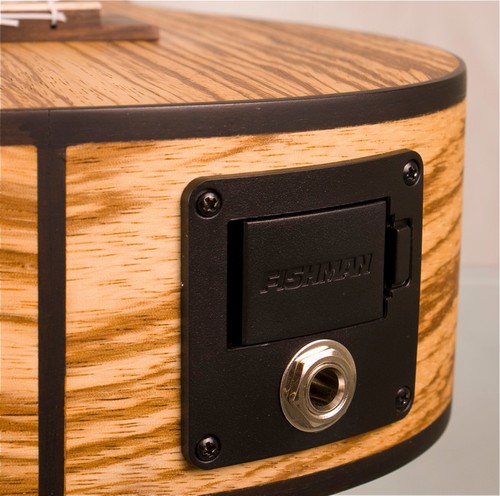
I assume most people will not choose an electro-acoustic model as their first instrument, although there is no reason not to if that is what you want. We will devote a separate post to electro-acoustic ukuleles later; for now, here is a picture of the amplifier output socket on the bottom of the instrument:
The points above show that there are many factors to consider when choosing and buying a ukulele, from price and manufacturer to size, so there really is no single guaranteed recipe. I would add one final suggestion: order online only if you are 100% certain that the instrument arriving will be exactly what you have in mind. And if a music shop has to order the model you want, it is better to wait the one or two weeks for it to arrive than to compromise on something that happens to be in stock but does not precisely meet your needs and expectations.