Cascha Carbon Fibre
Yes, Fibre, not Fiber. I also looked twice at first to make sure it was not a typo, because for some reason I distinctly remembered the material being spelled “fiber”. After a little online research, however, it turned out that “fibre” is also correct spelling. I first encountered the electro-acoustic sibling of this ukulele in person at one of last autumn's courses. I tried it with curiosity because I had already seen it in many videos and had read and heard nothing but good things about it, so I was excited to find out what a carbon-fibre ukulele would feel and sound like. To give away the conclusion in advance: very good. All my life I have thought—and perhaps will continue to think—that a “real” ukulele can only be made of wood, but the existence of this carbon-fibre instrument challenges my old-fashioned view. Wooden instruments will probably always be closer to my heart than those made of other materials, but to be fair, this carbon-fibre ukulele sounds astonishingly good, is incredibly loud, and is genuinely enjoyable to play.
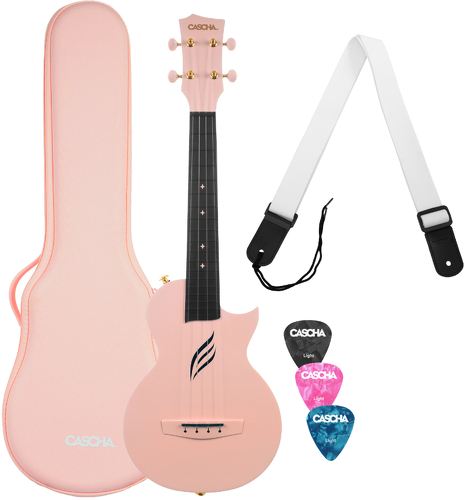
I tried a pink one. Not by accident: my little daughter received one for Christmas . I wanted a durable, “girly” ukulele for her that she could hold easily—so it also has a strap—that sounds good and is not as “serious” as my grown-up ukuleles .
The ukulele comes with a factory case that looks good, has a nicely designed shape, and is made from fairly rigid material, so it protects the instrument well. Or rather, it would protect it well, because unfortunately I had a small problem with the case. Incidentally, this ukulele is made only in concert size.
Enjoy the following demonstration video of the ukulele, in which the “case problem” is revealed as well.
 |