Strumming Techniques for Beginners
I have received several messages asking, "Okay, I can hold the chord, but what rhythm should I strum?" If I wanted to give the simple but not very helpful answer, I would say: strum in whatever way the particular song or musical style requires. That is actually true. The more music we listen to - especially the songs we later want to play on the ukulele - and the more attention we pay to it, the easier it becomes to imitate the rhythm we hear. Someone with no musical background may struggle with rhythm for the first month or two, but it is like drinking a litre and a half of milk after eating a kilo of plums: things will start moving very quickly.
The internet is full of "strumming patterns" that tell you the rhythm and whether to strum up or down. I have never really believed in learning rhythm this way, although there is no denying that when we play in a group we need to agree on some sort of pattern so that everyone is not scrubbing away at their instrument in a completely different way. In the how-to-play video about Pachelbel's Canon in D majorI also talk about strumming and arpeggios, and earlier, in the For New Ukulele Owners I - Holding and Strumming the Instrument post I also bored my dear blog readers with the subject in detail, but I am devoting another post to it now because the question keeps coming back: "how do I start strumming if yesterday was the first time I ever held a ukulele?"
So strumming patterns can be a useful starting point for anyone, but trust your own brain and your own hands: the instrument will become manageable without mechanically following any pre-designed pattern. In the video below I try to show that even extremely simple strumming can bring the ukulele to life. Once you can strum up and down confidently - and evenly! - rhythm and more complicated patterns gradually become embedded in your brain and start coming naturally from your hand.
Back to strumming patterns: on international ukulele forums and Facebook this is, in the best possible sense, an eternal debate - should beginners start learning the ukulele by memorizing strumming patterns, or without them? I always say that complete beginners are more likely to be distracted by having to imitate patterns, because there is already so much else to think about besides the strumming itself: chords, chord changes, keeping a steady pulse, and not dropping the instrument in the process... You do not need to learn a strumming pattern to master the absolute basics. Once you can comfortably play simple quarter-and-eighth-note rhythms, you can look at a few patterns and decide to learn them - or decide that you have as much use for them as a train wheel has for a bicycle pump. The truth is probably somewhere in the middle. For many, many songs there is genuinely no need to fuss over patterns, but in some cases it helps to pick up one or two, for example when a particular style demands it (Latin music, for instance; see Latin Tunes in the Forest), or - as I mentioned above - when several of us are playing together.
If you type "strumming pattern" into Google, you can frighten yourself with an enormous number of documents, such as this one:
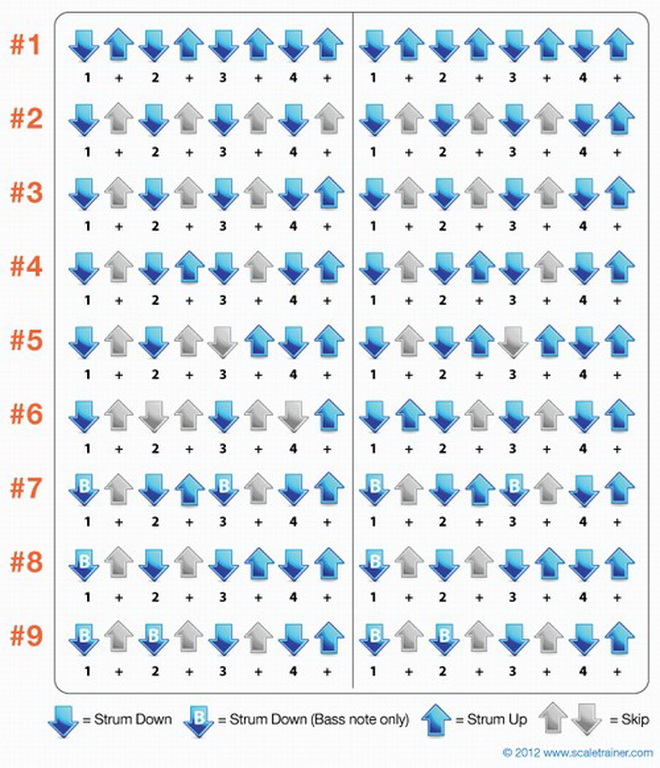
Now what beginner would not recoil at this sight and think, "I'd rather die" . So there is absolutely no need to worry: EVERYONE can learn to play the ukulele without memorizing patterns. Listen to lots and lots of music, practise patiently, pay attention to keeping a steady pulse, and you will soon get the hang of it!
So happy strumming everyone - be bold, precise and energetic!
For players who are no longer complete beginners, I warmly recommend the post about the chord progression of Five Foot Two, where we start learning a triplet strumming technique.