The Metronome
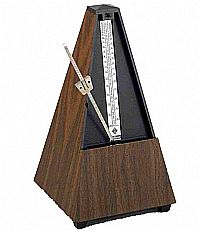 I know, the title is not exactly exciting — no “naked woman” or six-pack gentleman anywhere — but despite that we really do need to talk about the metronome because it is extremely important. I remember that during piano lessons as a child this square-based pyramid with a little metal rod would often appear, swinging steadily from side to side and tirelessly dictating ta-ta-ta-ta-ta-ta, to which my piano playing had to be aligned perfectly.
What exactly are we talking about? Thousands of people before me have surely written about steady pulse, metre and musical tempo, and entire libraries could be filled with the subject. Still, I will try to explain the essentials in my own words using an example. Listen to a song — almost anything will do (tip: Lenny Kravitz, Are You Gonna Go My Way). In almost any popular song there is likely to be a drum part whose sound is easy to distinguish if you listen carefully. What do you hear? Boom-tap-boom-tap — boom-tap-boom-tap — repeating. Sometimes it varies, sometimes the drummer plays a fill, sometimes the rhythm changes, but the primary job is to give the music a fundamental pulse. As a song moves forward, it also moves through time. That steady forward movement through time is what we call the pulse, and it establishes a constant tempo for the song. Naturally, slowing down and speeding up can be used as musical devices within a piece, but that is not especially common in popular music, so let us ignore it for now. While listening, do the following: start clapping along, as though you were sitting in the audience at a concert (“I can't see those hands!” ). Not difficult, is it? Who has not clapped at a concert or tapped a foot on the metro, prompting little smiles from fellow passengers? When we follow the song with claps or another regular body movement, we are physically marking its steady pulse.
Now turn the situation around. We pick up an instrument and begin to play. Our playing should also — in principle — have a steady pulse. Creating it ourselves is much harder than following music we can already hear, because our brain is occupied with so many other things: chords, the melody in our head, lyrics if we are singing, thinking ahead, and on top of all that keeping the pulse even. It is not easy. This is one reason beginners benefit from playing ukulele chords along with recordings. It is easier to adapt to music we can hear, and at the same time we practise steady playing almost without noticing. Uneven instrumental playing is one of the greatest sins we can commit. Returning to the previous example, naturally music has a pulse even without drums; the drum is simply the instrument that makes that pulse easiest to hear and feel directly.
If there happens to be no drummer available, or if we do not want to play along with a particular song, ametronomeis an excellent helper. A metronome is essentially an extremely simple drum machine. It has no drums of different timbres and pitches, no cymbals — just a simple click or beep. The mechanical metronomes I knew as a child, which had to be wound up, have gradually become less common. Today digital metronomes are more typical and are often combined with tuners. Even simple guitar-effects units may include a metronome function. The internet is full of metronome software, and countless metronome apps are available for phones as well, often combined with tuning apps. So what does a metronome help us do? We set its speed — more accurately, its tempo — often expressed as bpm, beats per minute, meaning how many beats it produces in one minute. Around 90–100 bpm gives a comfortable medium tempo. Once started, the metronome monotonously marks the beat like an infallible drummer. We have no choice but to adapt to it; our task is to follow the steady pulse it dictates as precisely as possible.
If our playing is not steady, it becomes obvious immediately when we play with other people. A band stays together only if everyone keeps the tempo accurately. The moment any instrument becomes even slightly inaccurate, we feel that the song — and the band — has “fallen apart”. Incidentally, bands count in “one-two-one-two-three-four” before a song precisely so that everyone starts together and shares the same tempo, not because it looks cool. In just a few seconds, the bandleader establishes the tempo that everyone else follows as soon as the playing begins.
As someone studies music for years and practises a great deal, the ability to play perfectly steadily without external help gradually improves. Some people need less practice and some more, but one thing is certain: it requires a lot of patient work. Practising with a metronome should never be skipped. It is not embarrassing in the slightest; it is extremely useful.
A great deal more could be written about the subject, but I hope the explanation above makes the basic purpose of the metronome clear. To make it even easier to understand, the following video demonstrates a metronome built into a clip-on tuner. In my opinion an instrument like this should be part of the basic equipment of every ukulele player — indeed every musician. Thank you to P. S. for this excellent little gadget!
Now then... I read online that sex can be used to sell anything, but probably nobody has ever used it to draw attention to the importance of a metronome. If you have actually read the post, watched the video and are still awake, your reward is to look at the two pictures below and remember this very, very clearly: both of these people consider metronome practice and steady strumming terribly important!
 |
 |
And after lots and lots of metronome practice, ladies and gentlemen can indeed develop in the directions shown in the pictures. (Hopefully the ladies are aiming for the left and the gentlemen for the right, although these days you never know...) A few comments on the photos: the original subject of the picture on the left was supposed to be the sea. Excellent proof is that the lady is not centred; when she noticed a photograph was being taken, she quickly jumped in from the left and sat cross-legged so that, as a joke on the photographer, she rather than the distant sea would appear in the shot. The picture on the right may be slightly misleading, because many people might think yours truly is shown there. The ukulele in his hands provides the decisive answer to that wandering thought — which, admittedly, is not very far from reality. The overall picture would roughly fit, but I have never encountered such an ugly green ukulele, so the conspiracy theory is exposed: that is not me in the picture. I am practising with a metronome instead...