Silent Night
The German lyrics of the Christmas carol Silent Night were written by the Austrian priest Josef Mohr under the title Stille Nacht, and the melody was composed by Franz X. Gruber in 1818. The melody commonly sung today differs slightly from Gruber's original, especially towards the end. The song was first performed at St Nicholas Church (St. Nikolaikirche) in Oberndorf bei Salzburg, Austria, on 25 December 1818. Mohr had written the words much earlier, in 1816, but it was only on Christmas Eve before the performance that he asked Gruber to compose a melody and guitar accompaniment for them. We do not know what gave him the idea; guitar music at the time was more typical of entertainment venues. Tradition says that the church organ was not working; in one popular version of the story, mice had chewed through the bellows. Gruber initially disagreed with Mohr because he feared the congregation would not like a guitar accompaniment, but he eventually agreed and wrote the music, influenced by the folk-music traditions of his native region. By the time he finished, only a few hours remained before Mass. The congregation arriving for Christmas Mass were initially surprised by the novelty of hearing the hymn accompanied by guitar, but they soon came to love the melody.
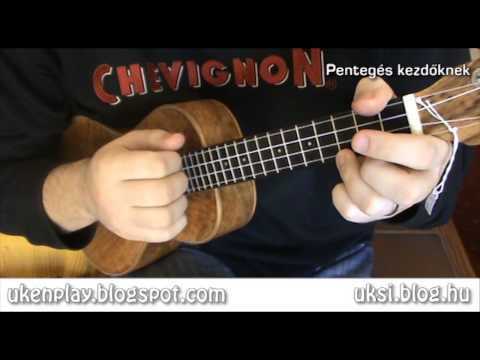
The video shows and plays my ukulele arrangement of Silent Night. This time I did not arrange the song using the usual method of simply strumming the chords; instead, we play both the melody and the chords on the instrument at the same time. For beginners this requires a little more patience and perseverance, but because there are no complicated chords or difficult melodic passages, this version can easily be learned by Christmas (and played under the Christmas tree as a surprise for the family ).
Update (4 November 2020): A kind and very enthusiastic fellow ukulele player, András, has recently prepared tablature for the arrangement shown in the video (adding F major in two places). I hope this makes it easier to learn; enjoy using it. A huge thank you to András for his work. Click it to open a larger version in a new window.