Getting to Know the Ukulele I
Parts of the ukulele and tuning
The picture below shows the parts of a ukulele. Because of its close relationship with the guitar, their names are exactly the same as the corresponding parts of a guitar (and a given part may have more than one accepted name):
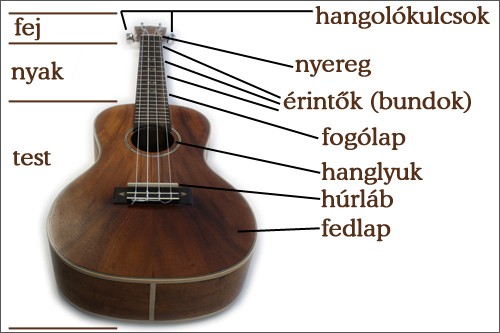
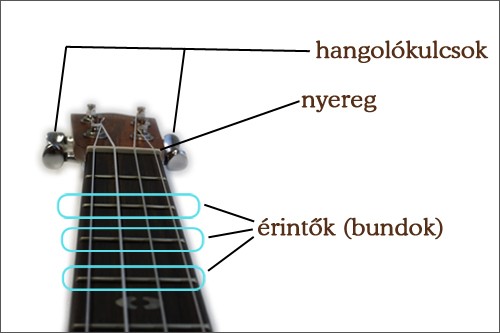
This is not of enormous practical importance, but it is still useful to know what the various parts of the instrument are called, rather than referring to a tuning peg as “that little twisty thing” and so on .
Tuning, on the other hand, is much more important. Beginners in particular may see it as a nuisance or find it difficult, but it really is not, and it is an essential step before playing the ukulele. So let us look at how to tune the instrument. I should say at the outset that I am describing standard tuning here. My aim is for a complete beginner who has just arrived home from the shop with a new ukulele to be able to manage, so this post does not cover special stringing or alternative tunings. (Readers with musical training, please be patient if something seems to be missing: I am deliberately avoiding even basic music-theory digressions in this post.)
If we hold the ukulele in the usual “guitar position”, the strings from top to bottom are called the G string, C string, E string and A string. I hope nobody needs “guitar position” explained (you have seen someone play a guitar, right??). For now, all you need to know about the string names is that they are named after the notes they produce. This G-C-E-A order applies when the neck is held in the left hand, as is usual for right-handed players. If we move the uke's neck to the right hand, as left-handed players often do, the order of the strings is immediately reversed. Of course it can be played that way too... but we will return to that later. Back to tuning: I assume we are not starting with an instrument that is catastrophically, absurdly out of tune. In that case, if we sound the strings one by one slowly, we can hear that the G string is relatively high, followed by a low C, then E and finally A.
On a properly tuned ukulele, the pitch of the “high” G string lies between the E and A strings. Anyone who has handled a conventional guitar will know that the strings are not ordered this way there: on a guitar they generally run from the lowest-pitched string to the highest as you move downwards. One special feature of the ukulele, therefore, is that its top string is a high string. This is also one of the things that gives the ukulele its very characteristic sound. (Some players replace this high G with a low G, meaning a G string pitched below the C string.)
So, to summarise: high G string, C string, E string, A string. How do we tune the uke's strings to these notes? There is absolute tuning and relative tuning. I favour absolute tuning, which means tuning each string to the actual note that gives it its name: G to G, C to C, and so on. (Naturally, the string designation is the same as the pitch at which it is intended to sound.) With relative tuning, we choose one string and tune all the others in relation to it. The G string may therefore not sound at an exact concert-pitch G, but a melody or chord played on the instrument will still be in tune internally because the pitches of the other three strings have been adjusted relative to the chosen reference string. If you have absolutely no tuning device available — not even a tuning fork — then relative tuning may be your only option, but it is almost completely unsuitable for playing together with other instruments. That is enough about relative tuning for now; I do not want to complicate matters. Perhaps we will return to it another time. For the moment, let us stick with the simpler and more reliable method of absolute tuning.
For absolute tuning we definitely need some kind of “external helper” that shows or checks in which direction the tension of a particular string needs to be adjusted. (I hardly need to say that turning the tuning pegs can tighten a string, raising its pitch, or loosen it, lowering its pitch.) Beginners should be patient: you will soon get the hang of it. Do not settle for an inaccurately tuned uke, because the chords will sound out of tune.
The easiest solution is to use a phone app or a tuner costing around HUF 2,000–3,000. These show on a scale whether a string is too low, too high or correctly tuned.
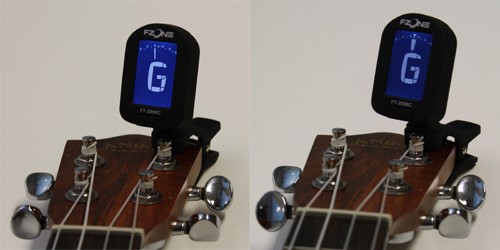
...the G string is still a little low... watch the position of the lower-left tuning peg!... in the picture on the right the G string is now correctly tuned!
It is worth noting that G-C-E-A tuning is characteristic of soprano, concert and tenor ukuleles. Depending on the string set, a baritone ukulele may instead be tuned D-G-B-E, but that will be the subject of another post...
Never skip accurate tuning: it is the foundation of playing the ukulele. Beginners should experiment patiently. At first it may take several minutes to get the tuning right, but with a little practice you will eventually be able to do it in 15–20 seconds.