Getting to Know the Ukulele II
Holding the ukulele
When we search YouTube for videos of professional ukulele players, naturally we pay most attention to the music itself and watch the musician's fingers on both hands. What may not even occur to us — because it is not especially spectacular — is that simply holding the instrument also requires a particular skill and some practice. Before I started playing ukulele, I read in several places that, depending on the size of the instrument, learning how to hold it securely against the body can take more or less practice. I am of course talking here about a ukulele without a shoulder strap; with a strap, this problem does not arise in the same way.
Because of its small size, a ukulele does not offer such an “obvious” hold as, say, a guitar (or a piano, hehe). When I first picked one up, I too immediately noticed that it was not quite as simple to hold as it looked. Despite its small size, it has to remain stable even when the left hand is not supporting the neck, while the right hand must remain free to strum. You need to practise patiently until the hold becomes secure. I may repeat “this is a matter of practice” too often, but it is an eternal truth when learning an instrument. In my own experience it is bloody difficult to play ukulele standing up unless you have a strap. Sitting down — perhaps with your legs crossed — and resting the ukulele in your lap is the easiest way to keep control of it. With daily practice, after a few weeks a beginner will find holding the instrument increasingly natural, and after a month or six weeks will barely have to fuss with repositioning the uke at all. (As a beginner I sometimes even rested the bottom of the ukulele against the arm of my chair .)
So: sit comfortably on a chair and forget about leaning back. Especially if the player is on the larger side and the ukulele is small, hold the instrument between your right elbow, forearm and lap (right thigh), making sure your right forearm touches only the soundboard and not the strings. (Sorry, left-handers: mirror everything.)
(As I mentioned earlier, beginners should not try to play a strapless ukulele while standing up!)
Strumming
If you have somehow not yet come across ukulele videos on YouTube, feel free to explore: there are countless arrangements and tutorials showing all kinds of strumming and picking techniques. Traditionally the ukulele is played with the fingers, most often the index finger, although techniques using the other fingers also exist. Picks are used only rarely because they give the ukulele a much sharper sound, which is seldom the aim. Occasionally a particular melody or accompaniment works especially well with a pick; naturally, in those cases one may be used.
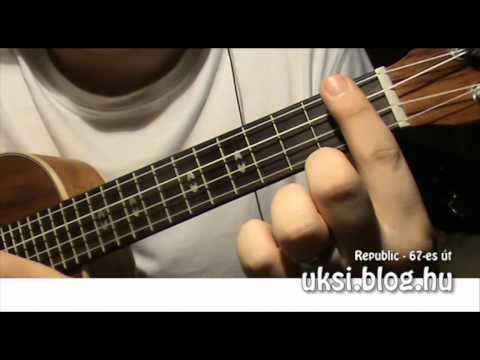
Returning to finger playing: the simplest form of strumming is to brush across the strings with the thumb. In practice we will use this technique only rarely when playing songs, because it is difficult to create a useful rhythm this way and it is not really suitable for making the ukulele sound in its usual way. It is more useful when tuning, to sound an individual string, or when learning a new chord, to hear how it sounds and whether the strings are being held down firmly enough with the left hand. So let us move on to the most common — and still simple — basic strum, played with the index finger as shown in the following video:
I could claim that the person in the video is me and that I somehow learned to write in Hungarian, but no. He is definitely a foreign chap. In this particular recording his fingernails are not long, although in other videos he appears with very long nails indeed. Let me reassure everyone that you can play ukulele perfectly well with short nails. As on guitar, long nails mainly help when plucking individual strings for melody playing or arpeggios; a complete beginner does not need them, and on the left hand short nails are actually preferable for fretting chords. Back to the video: the fellow — who makes very good tutorial videos, by the way — explains that we should practise strumming by simply gripping the uke's neck with the left hand and concentrating only on the right. Point at yourself with the index finger of your right hand, then rotate the wrist so that the finger points towards the floor, allowing the index finger to brush across the strings as it moves. You can repeat that indefinitely. The important thing is to move at a speed and angle that keep the index finger from catching between the strings, avoid attacking the strings too violently, yet remain decisive enough that the strings sound almost together. So there are quite a few requirements to satisfy at once, but — as I have written many times — practice makes perfect. It is not black magic; after a few weeks of experimenting and practising, it will work. The more interesting part comes later: deciding in what rhythm to repeat this hand movement, because that is what gives a song's accompaniment much of its basic character.
Soon we will begin getting to know the chords...