A visit to the Kamaka workshop
After a long time, here comes another guest post—and not just any guest post. A few months ago, in the Hungaria Ukulele Club Facebook group I saw a post by Gyuri, a fellow guitarist and ukulele player who was lucky enough to visit the workshop of Kamaka, one of the world's finest ukulele makers.
I wrote to him to ask about the details, because naturally his story immediately caught my interest. Gyuri was kind enough to surprise me with a long account complete with text, photos and video. Enjoy:
“It would be hard to say whether Somewhere Over the Rainbow or the film 50 First Dates first sparked my interest in and love for Hawaiian culture. The ukulele, as an iconic instrument of Hawaiian culture, became a central part of that interest because as an amateur musician and guitarist I had always considered it one of the happiest and most likeable instruments. I also cannot say exactly when the almost obsessive decision formed in me that one day I would get to Hawaii and bring a ukulele home from there. Getting to Hawaii is neither simple nor cheap, so the trip was a long time coming. I was waiting for the right occasion—and what better occasion could there be than marrying the greatest woman in the world and then going to one of the greatest places in the world for our honeymoon? And if we were already there, why not visit perhaps the most famous and historic Hawaiia ukulele workshop of all, Kamaka in Honolulu on the island of Oahu.
 My wife Flóra and I
The factory visit
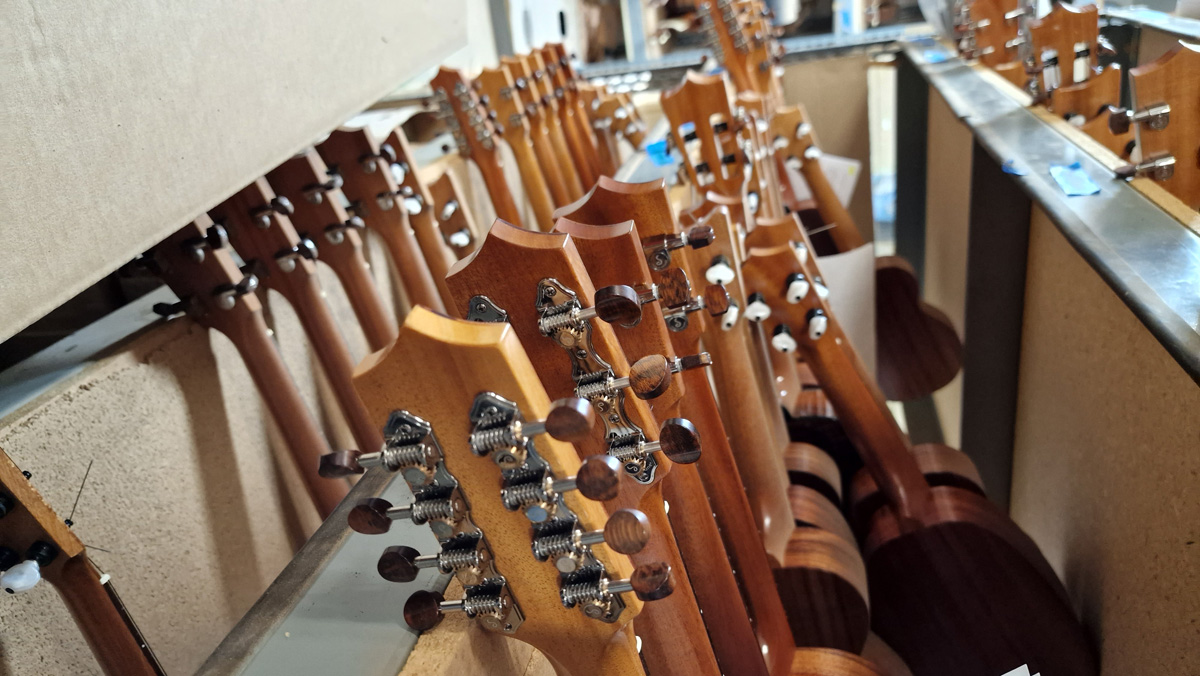
Most of the major Hawaiia ukulele brands—the famous “3 K's”: Kamaka, Kanilea and KoAloha—offer free workshop tours for visitors, during which they show the entire process of making a ukulele, from storing and processing the wood to the first tuning and quality control of the finished instrument. In Honolulu, where we were staying, both Kamaka and KoAloha have workshops, so we booked tours at both. KoAloha did let us into the reception area, but workshop tours were suspended because of Covid, so unfortunately we could not see how KoAloha instruments are made. At Kamaka, however, the workshop tour begins every day at 11:00, and the host who shows the processes is none other than Fred Kamaka Jr., whose grandfather began making ukuleles and founded the company. Our group included around 15 visitors from all over the world—Germany, the United States, Mexico, Japan, Portugal and, represented by us, Hungary. As you enter the workshop reception area, photographs of the Kamaka brothers who helped the family business flourish greet you on the opposite wall, and directly in front of you a display case contains extremely old, antique Kamaka instruments. After a few minutes' wait, Fred gives us a short presentation about the history of the ukulele and the role Kamaka played in the instrument's development and spread.
 |
 |
A few interesting facts from the history of the ukulele and Kamaka
Samuel Kamaka Sr. (1890–1953) learned the craft of making stringed instruments from respected instrument makers when he was young, and he was also a talented musician. He tried his hand at several occupations, including farming and seafaring, before founding “Kamaka Ukulele and Guitar Works” in the basement of his home in Hawaii in 1916, with the aim of creating the best ukulele. At first Samuel made 12 ukuleles a week by hand, working with great care and patience to give his instruments an outstanding sound. Demand for quality ukuleles was strong, and by 1920 he had a shop in Honolulu with two employees. Until the mid-1920s, ukuleles generally had a significantly thinner body than the shape we know today. Reforming the miniature guitar-like figure-eight shape, sometime in the mid-1920s he created what is now the classic pineapple form, which he patented in 1928. The ukulele remained a highly sought-after and popular instrument until around 1950, but with the rise of rock & roll interest shifted more toward guitars and electric guitars.
 |
 |
Kamaka Ukulele, however, persevered and continued making ukuleles. After Samuel Kamaka Sr. died, his son Samuel Kamaka Jr. took over the business and committed himself to continuing the traditions and quality established by his father. Under his leadership, Kamaka ukuleles continued to be famousfor their excellent quality and distinctive sound. Both the ukulele and Kamaka gained significant popularity in the second half of the 20th century, particularly as Hawaiian music became more popular. The ukulele's unique and cheerful sound attracted many people, and the instrument became a favourite of numerous famous musicians and performers. It became popular not only in Hawaii but around the world and found a place in many musical styles, including pop, folk and rock.
 |
 |
As an interesting example, the Kamaka family made the ukulele used in the film 50 First Dates at Adam Sandler's request and to his custom specifications. Last year Kevin Bacon also attracted a lot of attention with a video celebrating his 64th birthday, in which he plays a Kamaka. And anyone who has ever searched for “ukulele” on YouTube has surely come across Jake Shimabukuro, a Kamaka ambassador who plays his own custom Kamaka instrument. Perhaps his most famous video is this arrangement of Bohemian Rhapsody performed at a TED event.
 |
 |
Why are Kamaka ukuleles so special?
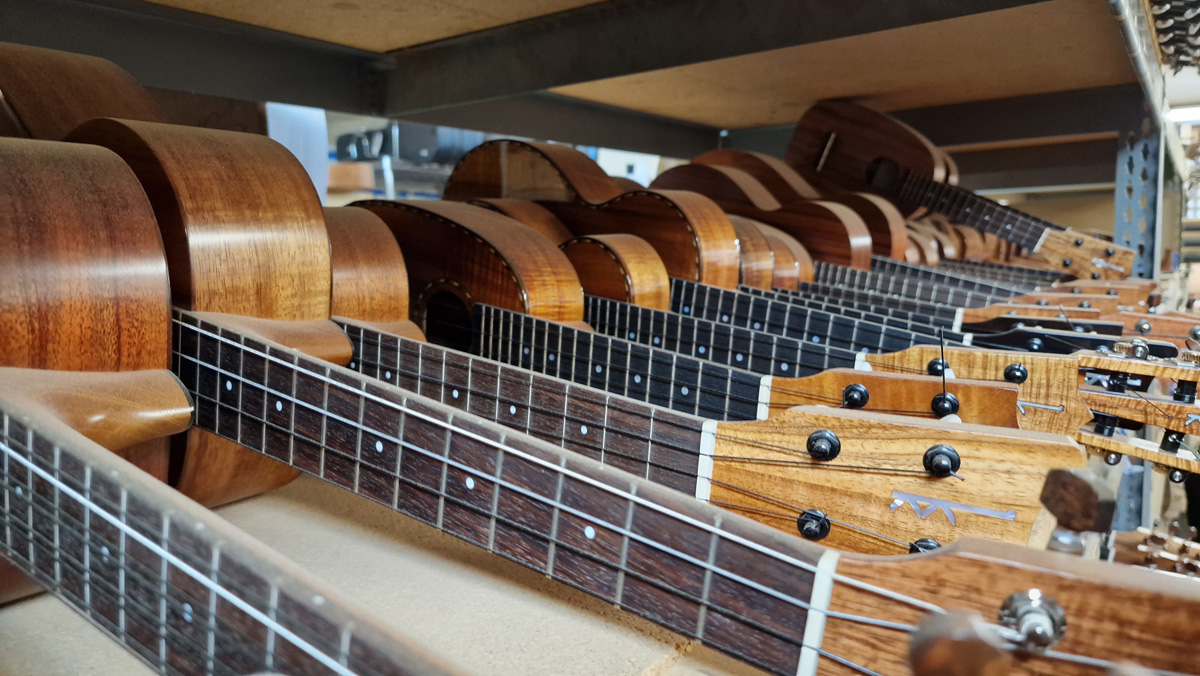
Kamaka is still owned by the Kamaka family today. If you think about how many crises, music-industry changes and trends the company has survived, very few businesses can say the same. They use exceptionally high-quality koa to make their ukuleles, a wood that plays a fundamental role in both sound and appearance. Koa is native to Hawaii and, in theory, is found only there; attempts to establish it elsewhere have not succeeded. That makes it rare, and its price reflects that. The distinctive dark-brown and reddish shades, special texture and beautiful grain give the ukuleles an especially attractive and unique appearance. Koa is also highly resonant and lightweight, contributing to a clear, warm sound.
 |
 |
 |
 |
 |
 |
 |
 |
 |
 |
Kamaka's makers carefully select the finest koa from Hawaiian forests and dry the felled wood for four years before using it for instruments, ensuring excellent sound and long life. And if that were not special enough: from felling the tree to fitting the first set of strings, only Hawaiian materials are handled exclusively by Hawaiian hands. What exactly they do and how they do it may be better shown on video . Here it is:
An unforgettable experience
During the 45 minutes we spent in the Kamaka workshop, we were able to learn every detail of ukulele making. There was no secret recipe and nothing was hidden, because the value and quality of Kamaka instruments do not come from tricks or unusual treatment methods. They come from more than 100 years of experience—always accompanied by innovation—and from the time, attention and care devoted to each instrument, all of which we could see with our own eyes in the workshop. A Kamaka ukulele is not cheap, but it is Hawaiian through and through, and every single instrument is an iconic embodiment of the aloha spirit.
The dream instrument will have to wait
After the workshop visit I felt that I was not worthy of a Kamaka—YET! Given that I could not really play the ukulele at the time, I felt it would simply be outrageous for me to begin my ukulele career with a Kamaka. I want to “earn” it and become worthy of it. And because I did not buy one this time, I now have a reason to return once I am a more experienced ukulele player. Of course life is unpredictable and there is no guarantee I will ever get back to Hawaii, so I did fulfil my dream of bringing a ukulele home from there. Twice over, in fact .
In the end I managed to buy a used Tangi Koa soprano on Craigslist—the local equivalent of a Hungarian second-hand marketplace—for a very friendly price. And although we could not take the KoAloha workshop tour, I managed to buy a factory-second concert ukulele made of mango wood. I immediately fell in love with its sound and still love playing it today. The Kamaka remained a dream, so I still have something to strive for.
 |
 |
But I will never part with the two little instruments I brought home from Hawaii, just as I had dreamed of doing as a child. They are not only fantastic instruments, but also reminders to me that with persistent work and planning we have a chance to make our dreams come true.”
Many thanks to Gyuri for this fantastic—and truly enviable—account .