Pachelbel's Canon in D
Pachelbel's name may not be familiar to everyone, but there are very few people who have never heard the chords of his Canon in D. This great Baroque composer created a chord progression that went on to inspire countless other composers and popular-song writers. The progression is catchy in the best possible sense: the harmonies follow one another so naturally that you feel as though you have always known the melody.
Pachelbel was born into a family of fourteen children, and his musical talent became apparent at a very young age. He was one of the most important organists and composers of the German Baroque in the second half of the seventeenth century and is regarded as one of Johann Sebastian Bach's most important predecessors.
Returning to the Canon in D, I recommend that everyone close their eyes, let their thoughts roam freely, and immerse themselves in this endless music:
The framework of the Canon in D consists of eight chords. It never becomes boring because we hear many different instruments playing varied melodies, rhythms and ornamentation over the chord progression.
The best thing, then, is to get as many people together as possible. Everyone can memorize the chords in a few minutes, and then we start playing... the same eight chords really can be repeated almost forever without becoming boring.
So: D, A, Bm, F#m, G, D, G, A
(In Hungarian notation the note B is traditionally written H, but in English notation we simply use B.)
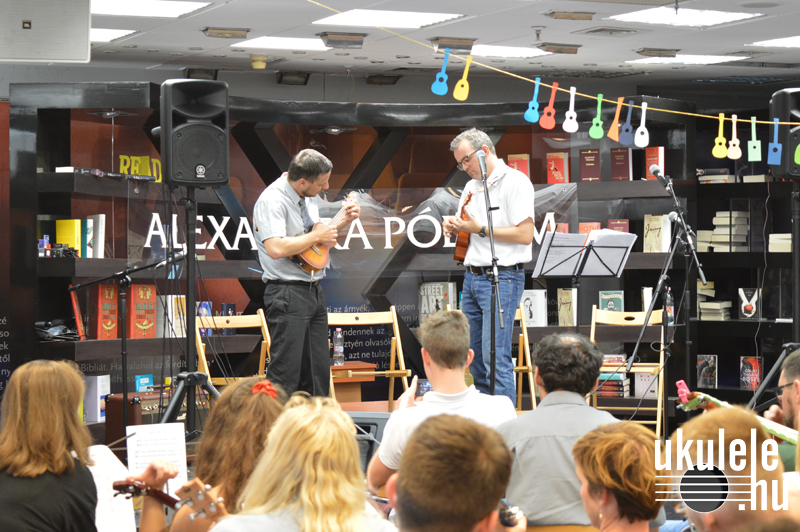
Even if we are alone, it is still worth picking up the ukulele. Repeating these chords is an excellent finger exercise, and at the same time we can practise different ways of strumming and picking (rhythmic strumming, arpeggios, and so on). Or call in your identical twin and form the Pachelbel Brothers .
There is an ugly, unforgivable tempo wobble near the beginning. We still need to practise - we just do not meet very often...