Chord sequences for warming up
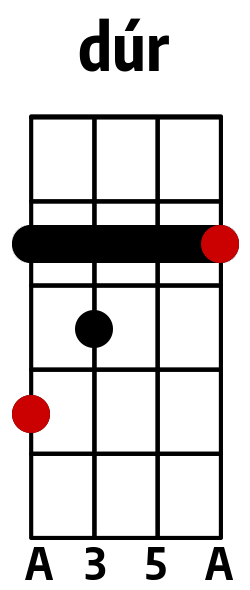
I would like to show you two chord sequences in the next video. I “developed” them a few years ago because I became bored with strumming the same basic chords as a warm-up or whenever I tried a new instrument. In these sequences we alternate between two chord shapes, and it does not matter where — meaning on which fret — we begin. We can also decide freely whether to move the hand up or down the neck: it will sound good either way. There is even a music-theory explanation for why these chords work so well one after another, but I will spare you that here. Below you can see the tablature for the two shapes used in the first sequence. If you are curious while playing about exactly which chord you are holding, find the note marked by the red dot, because you are playing the major chord built on that note — marked below as “A”, meaning the root. For example, if you hold the first shape at the third fret — so your index finger is on fret three — it is, perhaps surprisingly, a C major chord, a completely regular C major, because the red dot marks the note C. You can work out the chord produced by the second shape in exactly the same way.
 |
 |
And why do I barre all four strings with my index finger even though, strictly speaking, that is not necessary? I demonstrate this in my B-major video — and perhaps in the B-minor one too; I cannot remember off the top of my head — and we also discuss the advantages of this technique in detail during the ukulele courses. In fact, you do not need to think about it for long, because the advantage of the full barre becomes obvious while playing the sequence itself.
I will not say anything here about the second sequence; you can discover that one in the video. So here is the lesson. Practise these progressions patiently and persistently, because they can strengthen the fingers considerably and build endurance in the hand and forearm. Good luck !