The First Hungarian Ukulele Blog
My aim in creating this Hungaria ukulele blog is to introduce this wonderful little instrument to as many people as possible and inspire them to start playing.
In future I will try to write about as many interesting topics as possible — chords, songs, brands, ukulele equipment and my own experiences with all of these — in a way that allows both beginners and more advanced players to find posts that interest them. I will try to keep my explanations accessible so that complete beginners can understand the fundamentals, and in posts aimed at them I will also explain the basics of music theory.
Let us begin with the most important things to know about the ukulele. According to Wikipedia:
“The ukulele is a stringed instrument, essentially a small four-stringed relative of the guitar. Many people know it as the Hawaiian guitar, as it is a popular instrument in the Polynesian islands.
The ukulele is generally associated with the music of Hawaii, where its name roughly translates as ‘jumping flea’. It developed in the 1880s from the Portuguese braguinha and rajão. In 1879 three men arrived in Honolulu, Hawaii, from Portugal aboard the Ravenscrag and are regarded as the first ukulele makers: Manuel Nunes, José do Espírito Santo and Augusto Dias. One of them, Manuel Nunes, was a neighbour of the famous ukulele player Bill Tapiaand sold him his first instrument in 1915 for 75 cents.
Four main ukulele sizes are generally recognised, from smallest to largest: soprano (the original size), concert, tenor (since 1920) and baritone (since the late 1940s). Tenor instruments sometimes have doubled strings: six-string versions, in which the first and third strings are doubled, and eight-string versions, in which all four strings are doubled.
Ukuleles other than baritones are usually tuned to a C6 chord, G-C-E-A from the top string to the bottom, with the G raised by an octave so that its pitch lies between the E and A strings.
George Harrison became very interested in the ukulele during the final years of his life. He always carried two with him so that he would have someone to play with. Otherfamous people who have played the ukulele include Paul McCartney,Jimi Hendrix, Brian May, Neil Armstrong, Tony Blair and Elvis Presley."
(Source: http://hu.wikipedia.org/wiki/Ukulele— with a few small corrections to the Wikipedia description.)
I would add one point to the “official” description above: unfortunately, many places online call the ukulele a “children's guitar”, but that is simply not true. Its smaller size does not make it a children's guitar.
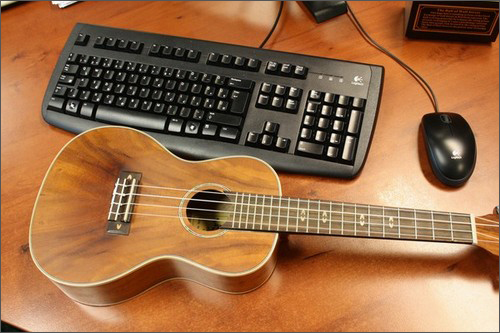
Anyone who has never seen a ukulele in person may find it hard to imagine its size. YouTube has countless ukulele videos and is well worth exploring; later I will devote individual posts to analysing some of the better or more unusual ones. I took a photograph of a concert-size ukulele so that the proportions are easy to see:
And finally, a little inspiration from the world's best ukulele player:
This level is probably beyond the reach of most of us, but Jake's playing is still a joy to watch. The video is perfect proof that the ukulele is not a toy instrument — unfortunately many people still regard it as one — but a serious musical instrument from which extraordinary things can be drawn with enough practice.