Give Peace a Chance
This song has a sadly topical relevance. I hope the war between Ukraine and Russia ends as soon as possible — a war that perhaps no one truly believed would happen .

According to Wikipedia, “Give Peace a Chance” is one of John Lennon's best-known songs. It was recorded on 31 May 1969 in room 1742 of the Queen Elizabeth Hotel in Montreal, and since then the room has reportedly become the hotel's most frequently requested room despite not being especially luxurious. Lennon had not yet written the song when a reporter at the hotel asked what exactly he wanted to achieve. Lennon replied, “All we are saying is give peace a chance,” and he liked the phrase. A few days later the famous recording was made. The song became an anthem for peace and is often sung at demonstrations.
Because the vocal is not backed by a large band, the song works extremely well with a single ukulele. In fact, it contains only two chords. I recommend it to beginners and advanced players alike because anyone who wants to play it in the original key will need barre chords:


...but if you prefer, you can play it a semitone lower, in which case all you need is a simple alternation between C major and G major:


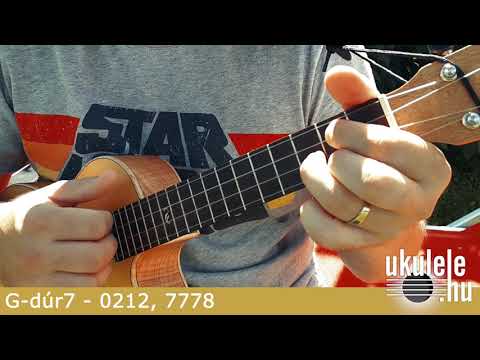
Of course the song can be transposed into any key; the important thing is that the major I and V chords alternate. The nice thing about the barre-chord version is that the rests — or rather the effects that replace those rests — can be played very effectively by “pumping” the barre shape. There is one way to make the chord progression slightly more complex: when we reach the “give peace...” section, we can use the seventh version of A-flat major — or G major in the lower key. I demonstrate this in the video.
You will also see two different ways of fingering D-flat major, and it is worth alternating them occasionally while playing so that the same D-flat shape does not become monotonous. At the beginning of the original recording there is accompaniment under the “spoken verse”, where Lennon recites the words. In later verses accompaniment appears sometimes, disappears at other times, or is simply very quiet. For simplicity, I accompany those sections only with rhythmic effects. Here is the arrangement, and I encourage everyone not only to try the easy version but the barre-chord one as well.