
Folsom Prison Blues
I have been planning for a long time to write a blog post about Johnny Cash and arrange one of his songs — and perhaps I will eventually do several. In my view he is one of those songwriters and performers everyone must have heard of, whether they like his music or not. His life would deserve a separate article, but I will not attempt that here; reading about everything that happened to him would take an entire evening, and there is also an excellent film about his life. He received an extraordinary number of awards and honours from the 1950s right up to the year of his death in 2003.
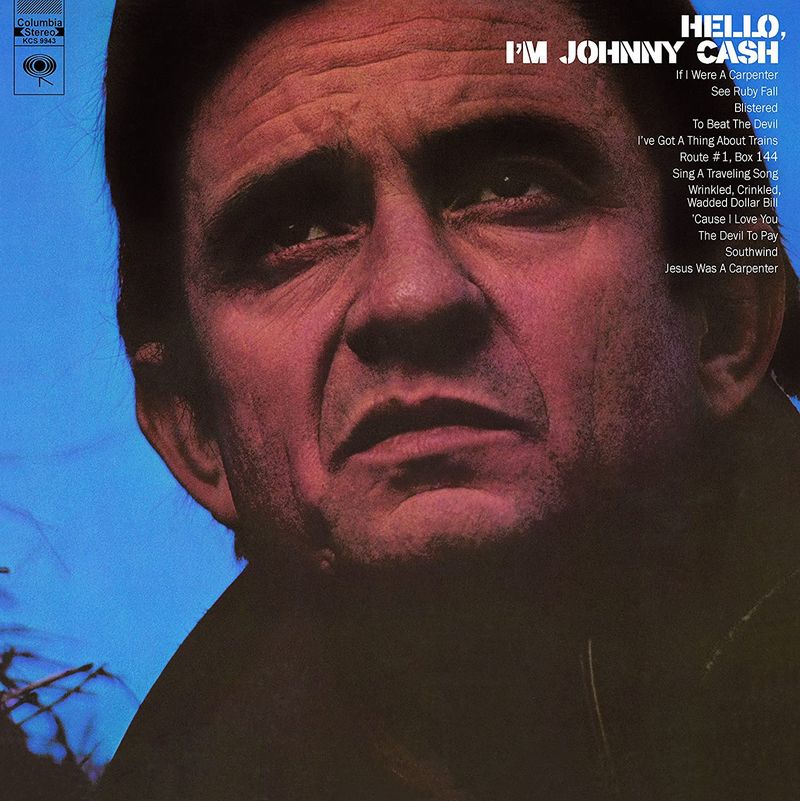
I remember that when I was a child my father often listened to Johnny Cash, so I encountered his songs even then. The first image I remember seeing of him was actually in one of my father's paintings: he reproduced the cover of the LP “Hello, I'm Johnny Cash” as an oil painting ... around 36 or 37 years ago.
Naturally, as an adult I now hear his music very differently and with different ears. I always find in it that extra quality I generally look for in music — the thing that ultimately makes me say whether I like a song or not. That “something extra” is different for every artist and difficult to define briefly. In Cash's case his voice is probably so distinctive that anyone who loves his music would mention it first. Beyond that, I would say there is a particularunmistakable simplicity and clarity in the chord changes, arrangements and structure of his songs, and I think that, combined with his overwhelming voice, is what captures the listener.
Two years ago, during one of the ukulele courses, an enthusiastic fellow ukulele player mentioned that she also loved Cash's music. I casually promised her that a post would eventually appear. She barely had to wait at all .
I play several Johnny Cash songs on ukulele, but eventually I chose Folsom Prison Blues, one of his iconic compositions. We can best reproduce the mood and authentic accompaniment of the song on ukulele by accenting beats 2 and 4, even though in a full-band studio or live arrangement that job is much more the responsibility of the rhythm section. With those accents, however, the ukulele can give the song an excellent pulse, and I think it suits it perfectly.
In the next video I also demonstrate the solo, but not the one heard on the studio recording. I use the version from one of the live performances, where the soloist adds one extra note to the melody. Since I arranged the song in F major, B-flat major inevitably appears. This is one of those chords beginners often dislike, but I encourage every beginner to give their hand a workout, struggle with B-flat major for a while, and it will come. Playing the accompaniment to this song is excellent practice for changing between F major and B-flat major. Here it is.
[F]I hear the train a comin', it's rollin' 'round the bend,
[F]And I ain't seen the sunshine since, I don't know when
I'm [B]stuck in Folsom Prison, and time keeps draggin' on [F] [F]
But that [C]train keeps a-rollin', on down to San An[F]tone.
[F]When I was just a baby, my Mama told me, "Son
[F]Always be a good boy, don't ever play with guns,"
[B]But I shot a man in Reno, just to watch him die [F] [F]
When I [C]hear that whistle blowin'
[C]I hang my head and [F]cry.
solo:
[F] [F] [F] [F]
[B] [B] [F] [F]
[C] [C] [F]
[F]I bet there's rich folks eatin' in a fancy dining car
[F]They're probably drinkin' coffee and smokin' big cigars
[B]But I know I had it comin', I know I can't be free [F] [F]
But those [C]people keep a-movin' and that's what tortures [F]me.
solo:
[F] [F] [F] [F]
[B] [B] [F] [F]
[C] [C] [F]
[F]Well, if they freed me from this prison, if that railroad train was mine
[F]I bet I'd move out over a little farther down the line
[B]Far from Folsom Prison, that's where I want to stay [F] [F]
And I'd [C]let that lonesome whistle blow my blues a[F]way.