Imagine — let's play together!
Happy New Year — may it be full of health and ukulele playing!
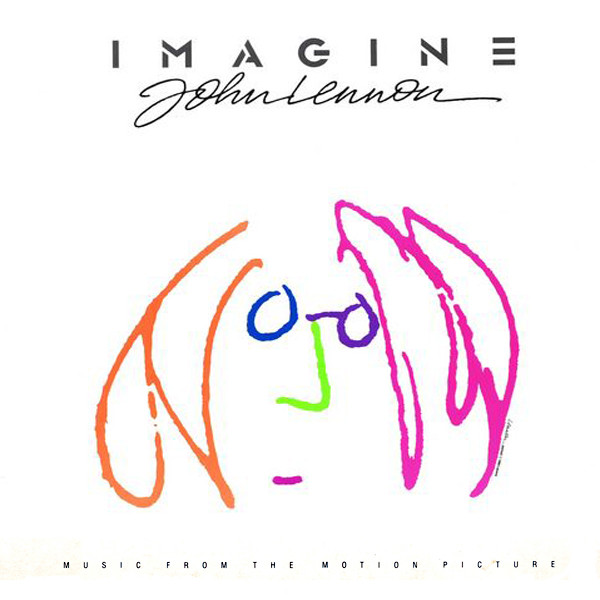
Imagine us all strumming together . That line is not actually in John Lennon's evergreen song, but I would love as many of you as possible to feel inspired to take part in the next community ukulele video. If you do not know what I mean, I recommend our earlier play-along projects, which you can watch by clicking here .
How did I choose Imagine? I do not really know. I had been thinking about several songs — in fact for months — and eventually rejected all of them. Then a few days ago, completely out of the blue, it suddenly struck me how perfect Imagine would be. With World Ukulele Day approaching, I would love us to surprise the Hungarian — and international — ukulele community with a production like this. So I hope as many of you as possible will join in.
This will be a slightly unusual blog post. I normally make a video explaining exactly what kind of recordings I would like you to send, and this time will be no different, except that the video will arrive a little later — hopefully in a few days. In the meantime I am publishing the written instructions so you can start getting ready and practising.
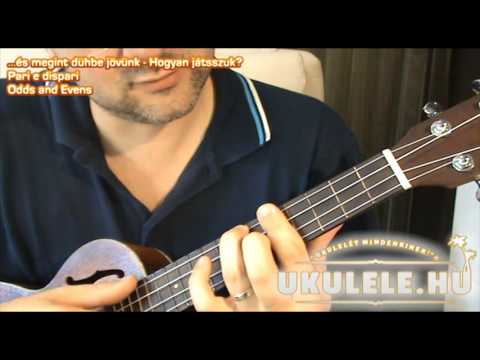
UPDATE: the video is finished and you can see it next to the song's chords. Below the chords I have also added the latest information about making your recording.
The song uses relatively simple chords, and what makes it truly distinctive are the little melodic figures at the ends of the lines. However, to make sure that many ukuleles sound good together, I ask you NOT to play those melodic figures, and we will also leave out G7. I will add those elements in a different way — for now, let that remain a secret.
So we will need the following chords:
 |
 |
 |
 |
 |
 |
As promised, in a few days I will post the video that you can use to record the ukulele accompaniment. Please make your recording with that video, because everyone will need to follow exactly the same tempo.
The strumming pattern will be very simple: steady downstrokes throughout — essentially one downstroke on each beat — with rests in a few places. I mark a rest with [szün]. You can see this, for example, at the ends of the bridges, where you strum the G major on beat one once and then rest for the following three quarter-note beats. In the chord sequence below, every chord symbol represents one quarter note, meaning one downstroke, except in the sections with singing. There each chord naturally lasts for as long as the corresponding lyric — normally two quarter-note beats. If you set a metronome to around 70–80 bpm, or play the original recording, you can practise with it. The chart only looks long at first glance; in reality, three types of blocks repeat, so please do not let the length of the song put you off .
The song appears twice in succession in the video, so if you want to practise you do not need to keep rewinding. During the second play-through I raised the volume in the sections where singing is possible, so the original recording — and Lennon's vocal — can be heard much more clearly and you can align yourself with it. I call out the chords in advance, about half a bar before they arrive, so while recording you should not need to look at anything; all the necessary information will be in your headphones.
[Intro]
As you know, the song has a short piano intro, but we are not playing that this time.
[Verse 1]
[C][C] [C] [C] [F][F] [F] [F]
[C][C] [C] [C][F][F] [F] [F]
[C][C] [C] [C][F][F] [F] [F]
[C][C] [C] [C][F][F] [F] [F]
[Bridge 1]
[F] [F] [Am] [Am]
[Dm] [Dm] [F] [F]
[G] [G] [G] [G]
[G] [szün] [szün] [szün]
[Verse 2]
[C][C] [C] [C][F][F] [F] [F]
[C][C] [C] [C][F][F] [F] [F]
[C][C] [C] [C][F][F] [F] [F]
[C][C] [C] [C][F][F] [F] [F]
[Bridge 2]
[F][F] [Am] [Am]
[Dm][Dm] [F] [F]
[G][G] [G] [G]
[G][szün] [szün] [szün]
[Chorus 1] SING HERE IF YOU WOULD LIKE TO!
[F]You may [G]say I'm a [C]dreamer [E7]
[F]But I'm [G]not the only [C]one [E7]
[F]I hope some [G]day you'll [C]join us [E7]
[F]And the [G]world will [C]be as one STRUM THE C MAJOR ONLY ONCE HERE, then rest for three quarter-note beats
[Verse 3]
[C][C] [C] [C][F][F] [F] [F]
[C][C] [C] [C][F][F] [F] [F]
[C][C] [C] [C][F][F] [F] [F]
[C][C] [C] [C][F][F] [F] [F]
[Bridge 3]
[F][F] [Am] [Am]
[Dm][Dm] [F] [F]
[G][G] [G] [G]
[G][szün] [szün] [szün]
[Chorus 2] SING HERE IF YOU WOULD LIKE TO!
[F]You may [G]say I'm a [C]dreamer [E7]
[F]But I'm [G]not the only [C]one [E7]
[F]I hope some [G]day you'll [C]join us [E7]
[F]And the [G]world will [C]live as oneSTRUM THE C MAJOR ONLY ONCE HERE
Finally, here is a summary of the most important points about making and submitting your video. The “official” part is that anyone who sends me a video consents to my processing and publishing that video without any time limit. So here is what you need to know:
- There are two ways you can record your video: 1. chord accompaniment only; 2. if you would like to sing the two chorus sections, sing those two choruses while continuing to play the chords. Everyone can of course decide which option they prefer, but please choose one of these two. Recordings that differ from them are very likely to be impossible for me to edit into the community production.
- Please record a HORIZONTAL, front-facing video that shows both your face and your ukulele while you play. This is important for editing: it would not look good if one person showed only their face while another showed only the instrument, and so on.
- If possible, keep background noise to a minimum and record in a well-lit place.
- My video must not be audible in your recording, because it would be impossible to remove it from the background during editing.
- Once again, please record horizontally and, if possible, in at least Full HD resolution. I cannot guarantee that videos with an unsuitable aspect ratio can be included, because positioning and resizing them is very time-consuming.
- Do not stop the recording immediately at the end. Wait about 10 seconds before stopping it — or before introducing yourself, see below.
Please do not send the recording via Facebook, because that significantly reduces the quality. I would like the original file, shared for example via Google Drive, WeTransfer, Mammutmail, Toldacuccot, etc.; please use info@ukulele.hu as the recipient. If you need a Gmail address for sharing, you can send material to ukuleleblog@gmail.com. If you have any questions before recording or about sending the file, write to the same address or leave a comment below the post.
Deadline: Sunday, 23 January 2022, 10:00 p.m. That is how long I will be waiting for your recordings. Then comes several hours — or days — of editing; the actual time will of course depend on how many videos arrive, hopefully as many as possible. With previous projects I started editing literally one minute after the deadline , and I expect the same will happen this time, so please do not submit your video late.
If you have not yet sent a video for one of our previous play-along projects, please introduce yourself briefly either by email or at the end of your video and tell me how long you have been playing. These introductions will not appear in the finished production; I will keep them for myself . I would be happy to get to know at least this much about those of you who will appear in the video. Have fun practising and good luck! I look forward to your videos. Thank you .