Chord progressions
Beginners and advanced players alike often ask the same question: what should I practise, and where do I go from here? More experienced players may find it easier to come up with ideas, but beginners who are still discovering the mysteries of chords can easily get stuck. I found a very useful little website that helps with exactly this problem. I had actually been planning to create a similar collection of chord progressions myself, but I think somebody beat me to it – and did a very good job. I came across the following site in one of the ukulele groups on Facebook: ukulelego.com
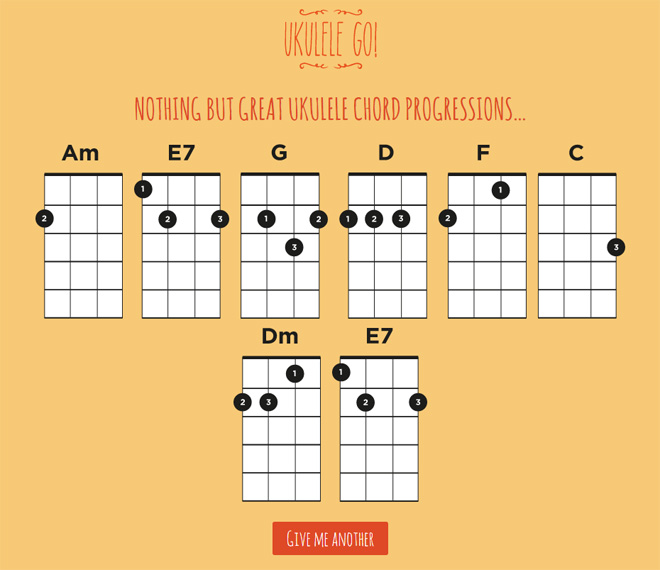
One interesting feature of the site is that it does not simply dump a huge collection of chord progressions on the screen. Instead, it gives you a new one at the press of a button – the “Give me another” button at the bottom. I deliberately took a screenshot of a longer progression, but even this one is not difficult to play because it consists entirely of basic chords. There are shorter progressions as well, of course. As I mentioned above, beginners can benefit from this in particular, because the site provides ready-made progressions that should sound good, and all we have to do is play through them – perhaps giving each chord one full 4/4 bar, with a simple one-two-three-four strumming pulse to begin with. The site is also excellent for beginners because it lets them practise chord changes. I have written this many times, and whenever I teach someone to play the ukulele I always say that one of the hardest things a beginner has to learn is to change chords at the correct tempo, almost without anyone noticing. If we have to stop and think between two chords, the song immediately falls apart and the performance is lost. More advanced players can benefit mainly because they may encounter chord progressions they have never played before. Once you can play a progression, it is worth memorising it and then playing it from memory. That is a major step forward: you no longer have to stare at the screen to see which chord comes next, and you can experiment with another rhythm or perhaps with arpeggios – instead of brushing across all the strings, you pluck them individually with your fingers.
I have no idea how large the site's chord-progression database is, but I hope it is as large as possible. One disadvantage is that you cannot download all the progressions as one big list and browse through them at your leisure. On the other hand, the approach is understandable: it encourages us to spend as much time as possible on ukulelego.com .
So my suggestion is: pick up your ukulele, keep pressing the Give me another button, play the progression, and if you like it, spend a little more time practising and memorising it. It can also be useful when you simply pick up the instrument and suddenly have no idea what to play, or when your friends say, “Come on, play us something,” and the familiar thought appears: “All right, but what...?” . At that moment, the chord progression you learned a few days earlier can suddenly come to the rescue.