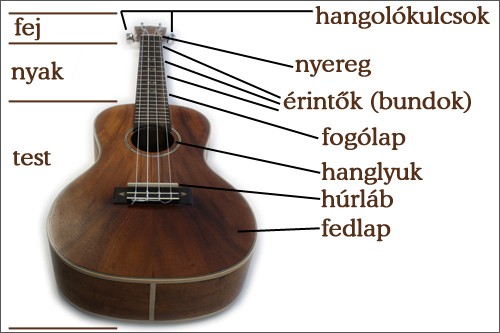
Buying a Ukulele for a Young Child
I receive a great many emails from parents asking what kind of ukulele they should choose for their child. I have already written a post about buying a ukulele “for adults” but in view of the many messages I receive, I will now try to summarise what I think is worth considering when choosing a ukulele for a young child.
First of all, the child's age matters. If your little one seems to have a good sense of rhythm — for example, moving steadily to music — that is a wonderful thing, but buying a ukulele for a child younger than about five or six will not mean that they can practise and play anything that could reasonably be called “music” on it. (I have received emails from people considering a ukulele as a gift for a two- or three-year-old.) There is nothing inherently wrong with that, but the child is likely to see the ukulele simply as an interestingly shaped toy: something to tap, hold and play with, rather than play on. Over the following months the child's interest in the ukulele “as an object” may fade and it may end up in the toy box beside the dump truck or doll. A ukulele is not an ideal toy, either, because its strings can present a hazard to a baby who grabs and pulls at them. The parental instinct — small child, small instrument, and introduce them early — is understandable, but in my view a parent is better off buying a ukulele for themselves and introducing the instrument to a child under five by playing it. Returning to safety: if a parent does give the instrument to such a young child, do not leave them unsupervised. Pulling at strings can cause injury, string ends may be sharp, and a child wrestling with the instrument can also knock themselves against its edges.
If a ukulele given very early survives several years of this treatment and is still usable when the child reaches five or six, then you are in a good position, although parental example remains important. A child of that age cannot reasonably be expected to teach themselves an instrument — even by watching YouTube videos — despite the fact that their fine motor control and ability to concentrate may by then be developing to the point where instrumental playing is possible. They still cannot focus on it in the same deliberate way as an older learner. The best way for them to learn is to imitate a parent: sit opposite or beside them and show them where to place their hands so that “nice sounds” come out of the ukulele. A five- or six-year-old may already be able to fret some simple chords, and with patient practice may also manage chord changes. At the same time, nothing should be “expected” of the child, and the activity certainly should not be forced, or it may put them off altogether.
But what instrument should we choose? If I answer completely honestly, I would say none for a child under five, for the reasons explained above. As with anything else, there is no need to rush a young child into “learning” instrumental music. They lose nothing by receiving their own instrument only around the age of five or six, or even a few years later. Until then it is quite enough for them to see a ukulele in our hands and perhaps help fret the chords or stop us strumming by crawling over curiously and planting a hand on the strings. We can also sit them on our lap and “play together”. If we are determined to give a ukulele as a gift, the main question is how much we are willing to spend knowing that the instrument may be worn out within a few months . If we accept the risk and buy not a few-thousand-forint toy but an entry-level soprano that survives those critical years in which the small child steps on the ukulele, throws it on the floor and pulls off the strings because they are not yet able to look after the instrument, then by around age six they may perhaps be able to strum a few chords. Another solution is to buy such an instrument for ourselves, learn a few chords and use it to accompany children's songs, thereby introducing the child to it. Later the child can “inherit” our soprano while we buy ourselves a more serious ukulele.
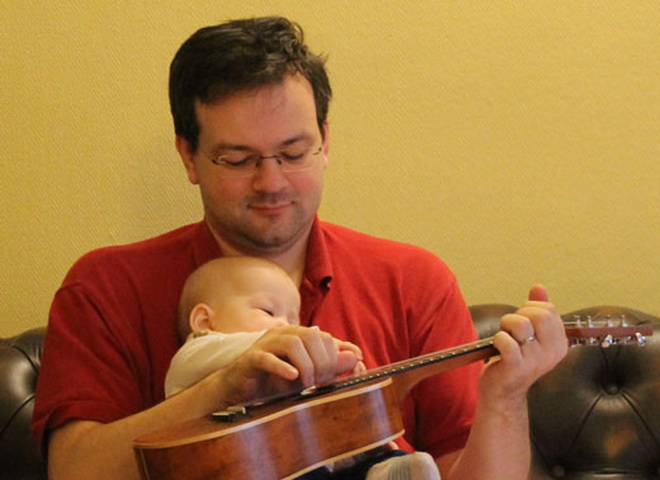
It is important to remember that the usual starting age for more formal instrumental learning is around six or seven — preferably closer to seven. By then the child's nervous system is sufficiently developed to coordinate the movements of hands and eyes, attention lasts longer and there is more patience to learn. Until then, however, live music at home — seeing and hearing parents play an instrument — is much more valuable to a child than simply putting an instrument in their hands for the purpose of “making music”.
As with so many questions in raising children, there is no perfectly clear and exact answer to “When and what kind of ukulele should I buy for my child?”, because every child develops at a different pace. Most likely, around the age of six or seven is when a child can begin becoming properly acquainted with a soprano ukulele. I emphasise again that there is no need to rush to put an instrument in a child's hands. Waiting a few months or even a few years does not mean falling behind. I hope the points above provide some useful ideas and information for making the decision. Always keep one thing in mind: do not hurry or force learning an instrument — just as you should not force other learning — because it can easily have the opposite effect.